Roughly 70 million Americans currently receive Social Security benefits, and tens of millions more have active my Social Security accounts they check for future planning. That enormous pool of targets is exactly why the Social Security Administration issued an urgent nationwide alert in early April 2026, warning of a sharp rise in fraudulent emails impersonating the agency ahead of that month’s retirement benefit disbursement. The scams are sophisticated, the urgency is engineered, and — as I learned in Boise last week — the timing can be devastating.
I met Bernice Norwood not through a press release or a tips inbox, but on a Tuesday morning delivery route with a Meals on Wheels volunteer named Carl Hutchins. Between stops in a quiet residential neighborhood on Boise’s north end, Carl mentioned a woman he’d met through his daughter — a hotel front desk manager who’d had “quite a month.” He gave me her number with her permission. Two days later, I was sitting across from Bernice at a corner table in a coffee shop near the Riverside Hotel, where she’s worked for eleven years.
A Month She Didn’t See Coming
Bernice Norwood is 56 years old, sharp-eyed, and chooses her words carefully. She manages front desk operations at a mid-size hotel, earning roughly $67,000 a year in base salary plus irregular quarterly bonuses that can add anywhere from $3,000 to $9,000 annually. Her husband, Marcus, has been a stay-at-home parent for their three children — ages 14, 17, and 21 — for the past eight years. On paper, they were doing fine.
In late February 2026, Bernice pulled their joint credit report for the first time in almost two years, preparing for a home equity conversation with their bank. What she found stopped her cold. Marcus had opened four credit cards without her knowledge between 2023 and 2025, accumulating a combined balance of just over $43,000. The purchases were spread across home goods, electronics, and what appeared to be at least one substantial cash advance she still hasn’t fully traced.
The weeks that followed were tense. Bernice and Marcus entered an uncomfortable negotiation — not just about the debt itself, but about what it meant for their retirement timeline. Bernice had been loosely planning to claim Social Security benefits at 64, not the early 62 cutoff but not the maximum 70 either. The discovery of $43,000 in hidden debt forced her to reconsider everything, including whether she might need to work longer than planned.
The Email That Arrived at the Worst Possible Moment
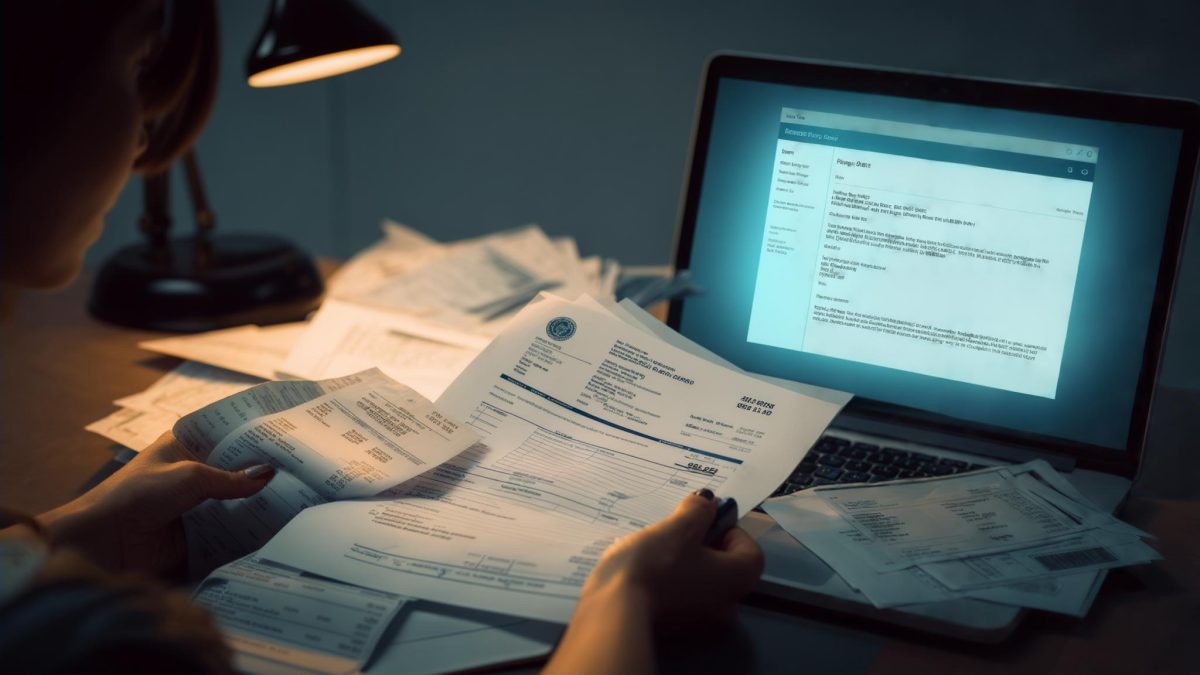
Three weeks into that marital and financial upheaval — in mid-March 2026 — Bernice opened her personal email on a Saturday morning and found a message that appeared to come directly from the Social Security Administration. The subject line read: “Action Required: Verify Your my Social Security Account — Potential Suspension.”
The email was polished. It carried the SSA’s official blue-and-white color scheme, a logo that looked right, and language that mimicked government formatting precisely. It told her that her account had been flagged for “unusual access activity” and that she needed to confirm her Social Security number and banking information within 48 hours to prevent a hold on her future benefits.
Bernice told me she sat with the email open for nearly four minutes. “I’m not someone who clicks on things. I’m careful,” she said. “But I was already in a headspace where I felt financially out of control. And the idea that something was wrong with my Social Security account — on top of everything else — I felt this spike of panic that I don’t normally feel.”
What stopped her was a detail in the sender’s email address. The domain ended in ssa-benefits-alert.net rather than ssa.gov. She noticed it only because she enlarged the text on her phone to read more carefully. She closed the email without clicking anything, then navigated directly to SSA’s fraud reporting page to confirm her suspicion and report the message.
Why SSA Scams Are Surging Right Now
Bernice’s experience is not isolated. According to The National Desk, the SSA specifically flagged an uptick in false email schemes timed to coincide with monthly retirement benefit payments — a deliberate strategy by scammers who know recipients are watching their accounts closely. The April 2026 warning explicitly told recipients to be on the lookout for fake calls, texts, emails, websites, social media messages, and even physical letters in the mail.
The scams share a common anatomy: they impersonate the SSA’s visual identity, manufacture urgency around account suspension or benefit holds, and demand either a Social Security number, banking credentials, or both. Some direct victims to spoofed websites built to harvest login information from my Social Security accounts.
What makes these scams particularly effective against people like Bernice — workers in their mid-50s who aren’t yet collecting benefits — is the element of future financial vulnerability. She had logged into her my Social Security account just weeks earlier to check her projected benefit estimates while processing the reality of Marcus’s debt. That recent activity made the email feel credible in a way it might not have otherwise.
“If that email had come six months ago, I probably would have deleted it in two seconds,” she told me. “But I had just been on that website. I had just been looking at my numbers. So my brain said, ‘This makes sense.’ That scared me more than anything — that the timing could do that to me.”
The Red Flags She Almost Missed
When I asked Bernice to walk me through the email in detail, a pattern emerged that matches exactly what SSA’s fraud prevention guidance describes. Understanding these markers is what separates a close call from a costly one.
Bernice forwarded the email to the SSA’s Office of the Inspector General and deleted it from her inbox. She then spent the next hour changing her my Social Security account password and enabling two-factor authentication — steps she hadn’t gotten around to despite having the account for three years.
Where Bernice Stands Now — and What Still Worries Her
The scam email turned out to be the smaller of Bernice’s two crises that month. The $43,000 in hidden debt remains the larger and more complicated problem. She and Marcus are now working with a financial counselor, and she has pushed her tentative retirement planning conversations back by at least eighteen months while they assess what the debt repayment timeline looks like. Her projected Social Security benefit at age 64, which she’d pulled from SSA.gov’s retirement estimator, was approximately $2,340 per month — a number that now feels more distant than it did in January.
“I’m not panicking about retirement,” she told me carefully. “But I’m also not as comfortable as I was three months ago. The scam email was almost a distraction from the bigger thing. Which is maybe the only silver lining — it reminded me to actually secure my accounts when I had been putting it off.”
That admission sat with me as I drove away from the coffee shop. Bernice is analytically minded, financially literate, and professionally composed. She manages hundreds of guest interactions a week, many of them involving fraud detection at the front desk. And she still came within one carefully read email address of handing her credentials to a scam operation. The SSA’s April 2026 warning isn’t alarmism — it’s an acknowledgment that these attacks are working, and that they are getting harder to distinguish from the real thing.
For anyone with a my Social Security account — regardless of whether you’re collecting benefits today — the calculus is simple: go to ssa.gov/scam, read the agency’s active warnings, and check that your account has two-factor authentication enabled. Bernice did it after a close call. You don’t have to wait for one.



Leave a Reply