

There is a three-year window that most Americans have never heard of. According to the Social Security Administration, correcting errors in your earnings record becomes substantially harder once that record is more than three years, three months, and fifteen days old — the point at which SSA’s standard correction process closes and the evidentiary burden shifts almost entirely onto you. For millions of workers who have never once logged into their SSA account, that window is closing quietly, every single year.
I heard about Dennis Dillard at a neighborhood barbecue in Richmond, Virginia, last March. A mutual friend — knowing I cover Social Security and government benefits — pulled me aside and said, almost apologetically, “You should really talk to this guy.” Dennis was standing near the grill, holding a paper plate and talking about his four-year-old daughter. He looked like someone who was used to carrying weight without mentioning it.
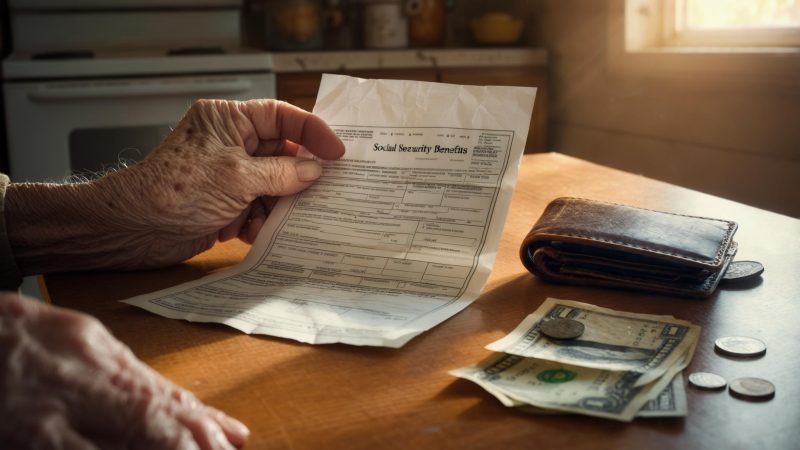
When I sat down with Dennis a few days later at a coffee shop near his apartment in the Scott’s Addition neighborhood, he had a manila folder on the table. Inside it were printed W-2s, a letter from the SSA, and two pages of handwritten notes. He pushed the folder toward me without saying anything, the way someone does when they’ve been trying to explain something for months and have run out of words.
A High Income That Doesn’t Feel Like One
Dennis Dillard, 31, is a petroleum engineer. He has been working in the field since graduating from Virginia Tech in 2016 and currently earns approximately $92,000 a year — a salary that, on paper, should provide some financial cushion. In practice, his monthly budget leaves almost nothing behind.
He has a four-year-old daughter. Her mother has not been financially involved since the child was two, and Dennis told me he does not expect that to change. Childcare alone costs him roughly $1,400 a month. He also sends between $400 and $600 every month to his mother and younger sister, who live in Roanoke and have faced sustained financial difficulty since his father passed in 2021.
His employer offers a 401(k) with a partial match. Dennis has never enrolled. “I kept meaning to,” he told me. “Every year I’d say, this is the year. And then something would come up.” He said it without self-pity — just the flat recognition of someone who has watched small decisions compound into a larger problem.
The identity theft started in late 2022. Someone used Dennis’s Social Security number to open four credit cards and a personal loan — approximately $22,000 in fraudulent debt — before he noticed the first irregularity on a bank statement in February 2023. By the time he filed reports with the FTC’s IdentityTheft.gov and the three major credit bureaus, the damage was extensive. His credit score, which had been in the mid-700s, dropped to 541.
The SSA Record Nobody Warned Him to Check
In January 2026, Dennis finally created an account at my Social Security — the SSA’s online portal where workers can review their complete earnings history, projected benefits, and any credits accumulated toward disability or survivor coverage. He told me he did it almost on a whim, after seeing a post on a personal finance forum.
What he found stopped him cold. His SSA earnings record for 2022 showed $51,200 in wages. His W-2 for that year showed $89,500. The gap — approximately $38,300 — was not a rounding error. Someone had been using a version of his Social Security number for employment during that period, and the wages from that fraudulent employment had, in some cases, displaced or undercut the accurate reporting of his own.
He also found a smaller discrepancy in his 2023 record — roughly $14,700 in reported wages missing from the SSA ledger. Combined, the two gaps represented over $53,000 in earnings that would not factor into his future benefit calculations unless corrected.
This matters more than it might seem for someone at 31. Social Security retirement benefits are calculated using a worker’s highest 35 years of indexed earnings. Errors early in a career — years when workers are building that foundation — can reduce benefit projections by meaningful amounts. For a worker who, like Dennis, has no private retirement savings whatsoever, a lower Social Security benefit is not an abstraction. It is the ballgame.
Filing the Correction — and What Happened Next
Dennis submitted a formal earnings discrepancy correction using SSA Form SSA-7008 in early February 2026. The process required him to gather and submit his W-2s for 2022 and 2023, his federal tax transcripts for both years, and documentation from his employer confirming the wages reported to the IRS. He told me the paperwork alone took him three evenings after his daughter went to sleep.
By late March 2026 — about seven weeks after he filed — the SSA sent him written confirmation that his 2022 earnings record had been corrected. The $38,300 gap was resolved. His projected retirement benefit at full retirement age ticked upward in his online account by approximately $90 per month, a figure that sounds modest but accumulates substantially over a 20-year retirement horizon.
The 2023 correction was still pending when I spoke with him in early April. He had not received any correspondence about its status. “I know I need to be patient,” he said. “But when you’re doing everything right and still waiting — that part is hard.”
The Bigger Picture Dennis Is Still Trying to Face
Resolving the SSA records was, by Dennis’s own account, the easiest part of his situation to address. The harder reality is the absence of any retirement savings at 31 — and the family financial obligations that have made saving feel structurally impossible rather than merely difficult.
He knows the math. He can run the numbers on what compounding growth would look like if he contributed 6% of his salary to his company’s 401(k) and captured the employer match. He has run those numbers. “I’ve done the calculator thing a hundred times,” he told me. “I know what I’m leaving on the table. I just haven’t been able to get to a place where I could actually start.”
His credit score, as of March 2026, had recovered to approximately 619 — still well below where it was before the identity theft, and still limiting his access to competitive rates on anything from auto loans to housing. He is renting a two-bedroom apartment in Richmond that costs $1,850 a month and has no near-term path to buying.
What Dennis’s situation illustrates is a pattern that appears across high-income earners more often than people expect: income does not automatically produce financial security, and the systems designed to support workers in retirement — including Social Security — are only as accurate as the data fed into them. An unchecked error, compounded over decades of benefit calculations, can quietly hollow out what should have been a meaningful safety net.
What Dennis Wants Other People His Age to Know
Before I left the coffee shop that afternoon, I asked Dennis whether, looking back, there was one thing he wished someone had told him when the identity theft first happened in 2022. He thought about it for a moment — actually thought about it, which I noticed — and then said something I did not expect.
He is not wrong. A credit report and an SSA earnings record are separate records maintained by entirely separate systems. Fraudulent employment under a stolen Social Security number does not necessarily appear on a credit bureau file — but it can silently corrupt the earnings ledger that will determine Social Security benefits decades from now. The two systems do not automatically talk to each other, and a person focused on repairing their credit after identity theft may never think to check the other record at all.
Dennis gathered his folder from the table, tucked it under his arm, and said he needed to pick up his daughter from daycare. He said it the way people say things when that is genuinely the most important thing on their schedule — not as a polite exit, but as a fact. He looked tired, in the specific way of someone who has been managing too many things for too long without adequate help. But not beaten. Just tired.
His 2023 SSA earnings correction is still pending. His credit is still rebuilding. His 401(k) remains unenrolled. These are not tidy endings, and I am not in the business of offering them. What I can say is that Dennis Dillard, at 31, now knows exactly where he stands with the Social Security Administration — and for the first time in three years, that is one less thing operating against him without his knowledge.
Related: A Factory Worker With $0 Saved for Retirement at 59 Is Counting on Social Security — The Math Is Brutal
Related: At 54 With No Retirement Savings, He Finally Opened His Social Security Statement — The Projected Check Was $1,240 a Month
.pvv-faq-section details summary::-webkit-details-marker{display:none}.pvv-faq-section details summary::marker{display:none;content:””}.pvv-faq-section details[open] summary .pvv-faq-arrow{transform:rotate(90deg)}



Leave a Reply