
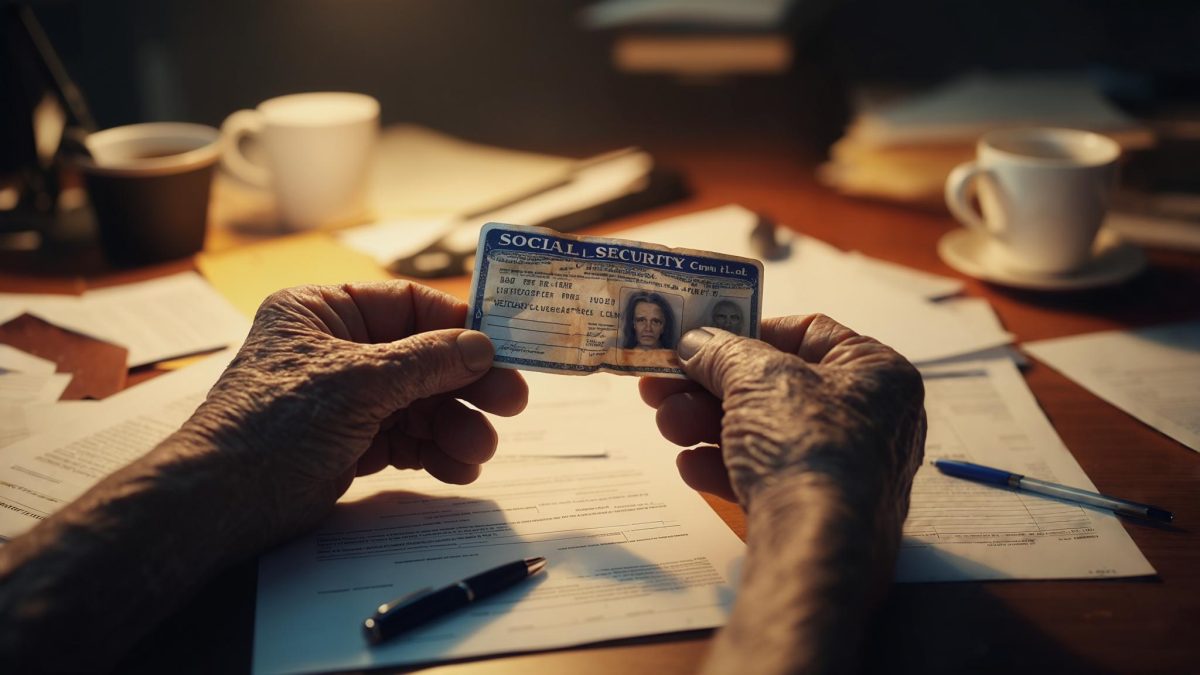
Have you ever checked your Social Security earnings record — not your credit report, not your bank statement, but the actual federal ledger that will one day determine what you’re owed in retirement? Most people haven’t. Warren Kessler, 29, hadn’t either, until a stranger’s crime forced his hand.
I met Warren in early February 2026, of all places, at a Winco Foods in Boise, Idaho. We ended up in the same checkout line, both reaching for the divider at the same time, and somehow got to talking. He was still in his security guard uniform — he works overnight shifts at a logistics warehouse on the south side of the city. When I mentioned I cover government benefits for a living, something shifted in his expression. “You know anything about Social Security records?” he asked. “Because mine’s been a disaster.”
We swapped numbers. Two weeks later, I sat down with Warren at a coffee shop near his apartment to hear the full story. What he described was not a simple case of a stolen credit card or a fraudulent loan. This was deeper, quieter, and in some ways more corrosive — someone had been using his Social Security number to work, and for roughly three years, the federal government had been recording their wages under his identity.
How the Identity Theft Started — and Why He Didn’t Know
Warren believes the breach happened sometime in late 2021, when he was 24. He had just moved from a shared apartment to his own place and used several online rental listing services to find housing. “Looking back, one of those sites was probably a scam,” he told me. “I entered everything — my name, my SSN, my date of birth — thinking I was filling out a rental application.”
Within months, collection notices started arriving. A credit card he never opened. A personal loan from a lender he’d never heard of. By mid-2022, his credit score had dropped from roughly 690 to below 520. He filed a police report, placed a fraud alert with the credit bureaus, and spent the better part of a year disputing accounts. What he didn’t do — what almost no one does at 24 — was log into his SSA My Social Security account to check whether anyone had been working under his number.
It wasn’t until January 2025 that Warren stumbled onto the problem. He’d started taking his finances more seriously after picking up a second part-time job to help cover his younger brother Dillon’s college tuition at Boise State University. Dillon is 21, studying engineering, and Warren has been contributing roughly $400 to $600 a month toward his expenses. “He doesn’t have anyone else,” Warren said simply. “Our mom passed when Dillon was in high school. So it’s me.”
Trying to project what his Social Security retirement benefit might look like someday, Warren created his My SSA account and pulled up his earnings history. What he saw stopped him cold.
The Numbers That Didn’t Add Up
Warren’s own employment history was relatively straightforward. He’s worked security jobs since he was 21, earning between $38,000 and $46,000 a year depending on overtime. His overtime income had been critical — he’d been clearing close to $52,000 in 2023 before his employer reduced overtime availability companywide in early 2024, a shift that cut roughly $8,400 out of his annual income and upended the budget he’d built around Dillon’s tuition schedule.
But his SSA earnings record showed something else. Between 2022 and 2024, there were wages attributed to his Social Security number from employers in two states he’d never worked in — a food processing company in Utah, and a landscaping business in Nevada. The combined reported earnings from those phantom jobs totaled approximately $31,200 across roughly 28 months.
“At first I thought maybe it was a system error,” Warren told me. “Like maybe the Social Security Administration had made a clerical mistake. But then I realized — no, someone has actually been going to work somewhere every week and telling their employer my Social Security number is theirs.”
Navigating the SSA Correction Process — and Why It’s Not Simple
Warren’s distrust of institutions runs deep. He described being dismissed by a bank representative when he first tried to dispute the fraudulent accounts in 2022, and being told by one collection agency that his fraud claim would “take time to review” while they continued contacting him. That history made him approach the SSA correction process with a level of skepticism that, frankly, turned out to be warranted.
According to the SSA’s guidance on earnings record corrections, workers who believe their record contains errors can request a review by submitting Form SSA-7008, along with documentation of actual employment — W-2s, pay stubs, tax returns. The process is designed to work, but it requires persistence and paperwork.
The IRS piece caught Warren completely off guard. Because the phantom employers had reported wages under his SSN, the IRS had a record of income he never received — which meant, on paper, he appeared to owe taxes on money he never touched. He had to file an IRS Identity Theft Affidavit (Form 14039) and work through the IRS Identity Protection Specialized Unit, a process that ran parallel to the SSA correction and added months to his ordeal.
“Nobody tells you that fixing your Social Security record might also mean fighting the IRS at the same time,” Warren told me. “I was dealing with two federal agencies, plus my credit report still had old fraud on it. I was 28 years old dealing with three separate bureaucratic nightmares.”
The Outcome — and What Was Left Unresolved
By the time I spoke with Warren in February 2026, the SSA had issued a corrected earnings statement removing the phantom wages. His official record now reflects only his actual employment income — approximately $197,000 in cumulative lifetime earnings since he started working at 18. The IRS case was closed with no additional tax liability. His credit score, rebuilt slowly since 2022, had climbed back to around 648.
But Warren is candid about what the experience cost him in ways that don’t show up in any document. He spent roughly 60 to 70 hours over ten months navigating phone queues, gathering documentation, and writing letters. He estimates he paid approximately $180 for certified mail and document copying fees. And during the months the IRS matter was unresolved, he couldn’t complete a rental application for a larger apartment — the one he’d hoped to get so Dillon could stay with him during school breaks rather than paying for campus housing.
He told me he now checks his SSA earnings record every six months and has placed a credit freeze with all three major bureaus. He set up an IRS Identity Protection PIN, a six-digit code that must be included on any federal tax return filed under his Social Security number. According to the IRS IP PIN program, this prevents someone else from filing a tax return using your SSN.
What he hasn’t done is fully let go of the suspicion he carries now toward every institution that asks for his personal information. “I’m not saying people shouldn’t use these systems,” he told me. “I’m just saying — verify your own records before someone else messes with them. Don’t assume everything is fine because nobody’s called you.”
What Warren’s Story Reveals About a Rarely Discussed Risk
Employment-related identity theft — where someone uses a stolen Social Security number to work rather than to open credit lines — is a category of fraud that receives far less public attention than credit fraud. Yet its consequences touch some of the most consequential financial records a person has: their lifetime earnings history, their eventual Social Security benefit calculation, and their federal tax record.
For someone like Warren, who is decades away from retirement but already paying close attention to what he’ll have available, an uncorrected earnings record could have distorted his future benefit estimates in either direction — inflating projected benefits based on phantom income, or, in some configurations, triggering administrative confusion about his actual work credits.
At 29, Warren has roughly 36 years before he reaches full retirement age under current law. He has time to correct course, and he did. But his story is a sharp reminder that Social Security records are not self-correcting. Errors — whether caused by identity theft, employer reporting mistakes, or data entry problems — can sit undetected for years unless the worker actively checks.
When I left the coffee shop that afternoon, Warren was heading back for another overnight shift. He looked tired in the way that people do when they’ve been managing too many problems at once for too long. “I just want things to be boring for a while,” he said, pulling on his jacket. “Boring would be really nice.”
I thought about that on the drive home. For most people, their Social Security record is something they’ll think about someday — when retirement is close, when something goes wrong. Warren didn’t have that luxury. At 29, working overnight shifts and putting his brother through college, he was already doing the work that most people put off for decades. The tragedy isn’t that the system failed him. It’s that he had to find out it failed him at all.
Related: A Factory Worker With $0 Saved for Retirement at 59 Is Counting on Social Security — The Math Is Brutal
Related: Glenn Fitzgerald Gets $1,847 a Month From Social Security. His Twin 3-Year-Olds Cost Nearly Double That




Leave a Reply