

The folding chairs in the Albuquerque VFW hall were still warm from the previous meeting when Glenda Kirby sat down across from me, a cup of lukewarm coffee cradled in both hands. She had driven forty minutes from her apartment in the South Valley — an irony she acknowledged with a short, tired laugh, given that driving is exactly what landed her in this mess.
I connected with Glenda through a veterans’ support group that her husband Marcus, an Army veteran, attends regularly. A coordinator there mentioned that Glenda had been quietly navigating a particularly complicated tangle of denied claims, defaulted loans, and Social Security paperwork — and that she had just received a piece of news that changed things, at least a little. When I reached out, she agreed to meet and walk me through the past eighteen months of her life.
The Injury That Started Everything
In September 2024, Glenda was finishing a night shift when another vehicle ran a red light and clipped the rear of her car near Central Avenue. She was taken to Presbyterian Hospital with a herniated disc in her lower back. Physical therapy bills started arriving within weeks — roughly $340 per session, three times a week.
What Glenda didn’t fully understand at the time was that as an Uber driver classified as an independent contractor, traditional workers’ compensation protections were largely unavailable to her. She filed a claim anyway. In November 2024, it was denied.
“When they denied the claim, I honestly didn’t know where to turn,” Glenda told me. “I had a teenager at home, a husband still dealing with his own health stuff from the service, and I’m the one who keeps the lights on.”
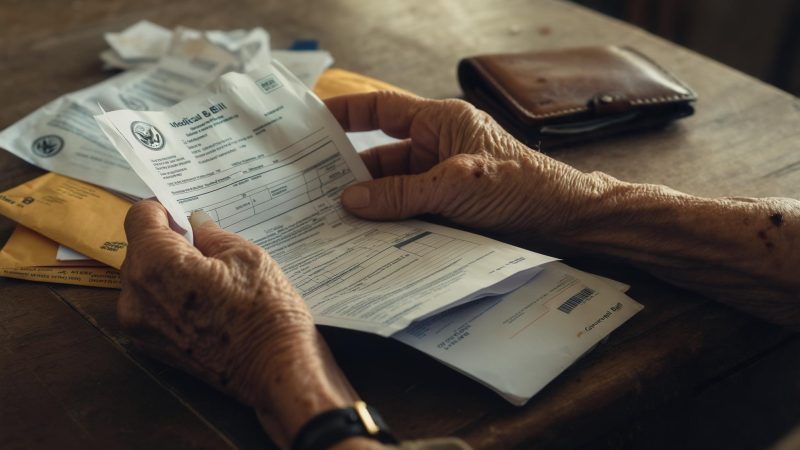
The injury forced her off the road for four months. Her household income — which had been running around $2,800 per month from driving after expenses — effectively collapsed. Then came a second blow: a $9,200 personal loan she had cosigned for a close friend went into default in the summer of 2024, just months before the accident. Her credit score dropped more than 80 points. The combined weight of medical debt, lost income, and the defaulted cosigned loan pushed the family to the financial edge.
Turning to Social Security Disability Insurance
At one of Marcus’s veterans’ group meetings, another spouse mentioned Social Security Disability Insurance — SSDI — as a possibility. Glenda had heard the term but assumed it was only for older people or those with severe permanent disabilities. According to the Social Security Administration, SSDI is available to workers of any age who have a qualifying disability expected to last at least 12 months, provided they have enough work credits built up through payroll taxes.
Glenda filed her SSDI application in January 2025. What followed was months of paperwork, repeated medical documentation requests, and waiting. The average processing time for an initial SSDI decision can stretch six months or longer, and that’s before any appeals.
“I kept waiting for a letter that would tell me something definitive,” Glenda said. “Every week I’d check the mailbox hoping it wouldn’t be another request for more records.”
Meanwhile, 2026 arrived with news about Social Security that would directly affect anyone receiving — or hoping to receive — benefits. A 2.8% cost-of-living adjustment took effect for Social Security recipients in January 2026, according to Kiplinger’s 2026 Social Security breakdown. On paper, that sounds like good news. In practice, it is considerably more complicated.
The 2026 COLA — And Why It Doesn’t Go as Far as It Sounds
The 2.8% COLA represents a real increase in monthly benefit checks. But the gains are being eroded by rising Medicare costs. Medicare Part B premiums climbed from $185.00 to $202.90 per month — a jump of nearly 10% — which directly reduces the net benefit for roughly 68 million Americans enrolled in both Social Security and Medicare.
As Yahoo Finance reported, the average net COLA for dual enrollees — those receiving both Social Security and Medicare — is far less impressive once premium increases are subtracted. For many recipients, nearly a third of the COLA benefit is consumed by Medicare costs before it reaches their bank account.
“I read about the COLA online and thought, okay, maybe this will actually help,” Glenda told me. “Then I saw that Medicare was eating a lot of it up for people already on benefits. That scared me. Because if I get approved for SSDI, that’s the system I’m going to be relying on.”
The Small Win — and the Fear Underneath It
In February 2026, Glenda received word that her SSDI application had passed the initial review stage and was moving forward for a full medical determination. It was not an approval — but it wasn’t a denial either. For someone who had been living in the fog of bureaucratic uncertainty for over a year, it was enough to exhale.
If approved, her estimated SSDI monthly benefit would be approximately $1,050, based on her work history and earnings record — a number that reflects years of gig work wages that weren’t always fully captured on tax documents. That amount would be substantially less than her previous income of $2,800 per month, but it would be something steady in a life that had felt anything but.
Her teenager, now 17, is looking at community colleges in New Mexico. The FAFSA has already been submitted, and Glenda is hoping that her reduced household income this year — documented through tax filings — will open up more financial aid. “My kid deserves a shot,” she said quietly. “That’s what I’m working toward.”
What Glenda’s Story Reflects About the Broader System
Glenda’s situation is a window into how the social safety net strains under the weight of gig economy realities, rising healthcare costs, and a benefits structure that wasn’t originally built with 32-year-olds in mind. According to the Social Security Administration, the program is designed to provide financial protection across all of life’s stages — not just retirement. But navigating it without guidance is genuinely difficult, especially when multiple financial problems stack up at once.
The 2026 COLA of 2.8% is real, but so is the pattern it reflects. Medical expenses, housing, and food have all climbed faster than the COLA formula captures, a dynamic that affects SSDI recipients as much as retirees. As NewsNation noted in its 2026 overview, this year’s Social Security changes ripple through the wallets of everyone who depends on the program — not just those near retirement age.
Glenda is keenly aware that even a full SSDI approval won’t resolve everything. Her estimated $1,050 monthly benefit, combined with Marcus’s VA income, still leaves the family well below what they were earning before the accident. The defaulted cosigned loan remains a weight on her credit. And a teenager heading to college next fall isn’t a cost that waits for anyone’s paperwork to clear.
When I asked her what she wished she had known before all of this, she paused for a long moment. “I wish I had known that gig work doesn’t protect you,” she said. “Every mile I drove, I thought I was building something. I had no idea how exposed I really was.”
As I left the VFW hall that evening, Glenda was already on her phone — not taking a ride request, but checking the SSA’s online portal for any update on her case. The hope in her voice when we spoke was genuine. So was the fear running just underneath it. She is one decision, one denial letter, one unexpected bill away from a very different outcome than the one she’s working toward.
That gap — between a system designed to catch people when they fall and the grinding reality of trying to catch yourself within it — is what Glenda Kirby carries every single day. And it is what makes her story worth telling.
(function(){var w=document.getElementById(‘pvv-scenario-s1775655358596k7s6’);if(!w)return;var btns=w.querySelectorAll(‘button[data-choice]’);btns.forEach(function(b){b.addEventListener(‘click’,function(){if(w.dataset.revealed)return;w.dataset.revealed=’1′;btns.forEach(function(x){x.style.opacity=x===b?’1′:’0.45′;x.style.cursor=’default’;x.style.transform=’none’});var o=document.getElementById(‘s1775655358596k7s6-out-‘+b.dataset.choice);if(o){o.style.display=’block’}});b.addEventListener(‘mouseenter’,function(){if(!w.dataset.revealed){b.style.borderColor=’#38bdf8′;b.style.transform=’translateX(4px)’}});b.addEventListener(‘mouseleave’,function(){if(!w.dataset.revealed){b.style.borderColor=’#334155′;b.style.transform=’none’}})})})();
.pvv-faq-section details summary::-webkit-details-marker{display:none}.pvv-faq-section details summary::marker{display:none;content:””}.pvv-faq-section details[open] summary .pvv-faq-arrow{transform:rotate(90deg)}



Leave a Reply