

Checking your Social Security statement before 50 is considered, by most financial conventional wisdom, a waste of worry. The thinking goes: you’re too young, the rules will change, the numbers are too abstract to matter yet. What that advice ignores is that the damage to your future benefit is often already done long before middle age — and the people least likely to check are the ones who can least afford to be surprised.
Janine Guzman reached out to me in January of this year, a few weeks after reading a piece I wrote about divorced women and Social Security for Benefit Beat. Her email was direct and a little guarded. She said she related to the story, that she had questions no one seemed able to answer clearly, and that she wasn’t sure her situation even merited telling. It did.
A Life Rebuilt on a Shaky Foundation
When I sat down with Janine Guzman at a coffee shop near her apartment in north Raleigh last February, she arrived seven minutes early, ordered a black coffee, and had a small notebook on the table before I even opened my bag. She is 40 years old, works as a dental assistant at a private practice in Cary, and earns roughly $58,000 a year — a comfortable income in most of the country, but a squeezed one in a city where her mortgage runs $2,180 a month.
She and her ex-husband finalized their divorce in March 2023, after nine years of marriage. The house — a three-bedroom in a suburb east of Raleigh — was purchased together in 2018 for $312,000. Janine kept it. The mortgage stayed too.
Her ex-husband had two children from a prior relationship. During the marriage, Janine contributed roughly $1,200 to $1,400 a month toward childcare and after-school costs — expenses she took on voluntarily, she said, because she believed in the family they were building. When the marriage ended, those children went with their father. The financial hole they left behind stayed with Janine.
The Statement She Hadn’t Opened in Six Years
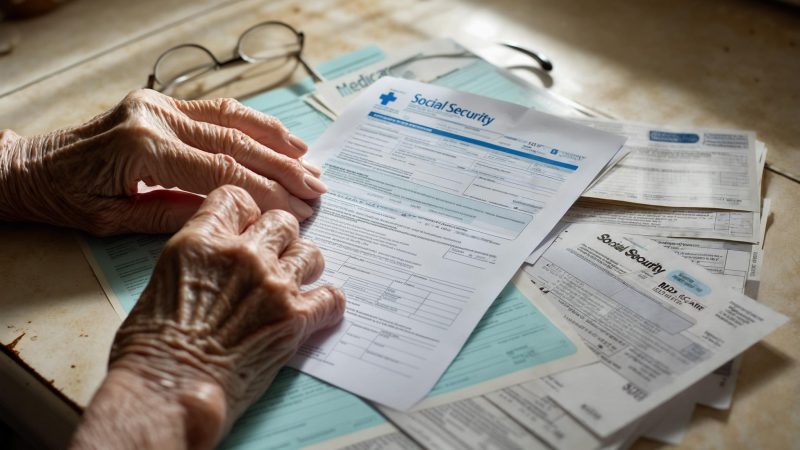
The Social Security Administration makes earnings statements available online through its my Social Security portal, and mails paper statements to workers 60 and older who are not yet receiving benefits. For workers under 60 without an online account, those statements don’t automatically arrive. Janine had created an account in 2018 and then, as she put it, forgot it existed.
She logged back in last October, after reading my earlier story. What she found was a projected retirement benefit of approximately $1,290 per month at full retirement age — currently 67 for her birth year. For context, the average Social Security retirement benefit as of early 2026 is roughly $1,976 per month, according to SSA data.
Janine Guzman told me she stared at that number for a long time. She had no specific figure in mind before seeing it, but $1,290 landed differently than she expected. “I think I assumed it would be higher just because I’d been working since I was 19,” she said. “I didn’t really understand that it’s about how much you earned, not just how long you worked.”
Social Security retirement benefits are calculated using a worker’s 35 highest-earning years. Years with zero or very low earnings count as zeroes and drag the average down. Janine’s earnings in her early twenties — before dental assistant certification — were modest. Several years during her marriage, when childcare costs consumed a large portion of her take-home pay and she worked reduced hours to manage the household, her taxable earnings dipped as well.
The Divorced Spouse Rule She Missed by One Year
This is the part of Janine’s story that I found most difficult to report, because there is no softening it. The SSA allows divorced individuals to claim benefits based on an ex-spouse’s earnings record — potentially receiving up to 50 percent of the ex-spouse’s full retirement benefit — but only if the marriage lasted at least 10 years. Janine’s marriage lasted nine.
Janine’s ex-husband, a project manager who had earned significantly more throughout the marriage, would likely have qualified her for a divorced spouse benefit well above her own projected amount — had the marriage reached the decade mark. She learned this only after she began researching online and eventually called the SSA directly in November 2025. The representative confirmed what she had already begun to suspect.
Janine is quick to add that she would not have stayed in a difficult marriage simply to qualify for a benefit she didn’t know existed. That isn’t the point. The point, as she sees it, is that nobody told her this rule existed when she was navigating the divorce. Not her attorney, not anyone at the courthouse, not anyone in her immediate circle. The information gap, she said, felt less like bad luck and more like a systemic failure.
What She Is Doing Differently Now
Janine does not have a financial advisor. She has looked into working with one but finds the fee structures confusing and, as she put it, feels embarrassed by the state of her finances. This is one of the ways her pride works against her — she would rather research alone than admit to a professional that she is, at 40, starting from something close to scratch on retirement savings.
When I asked Janine what she wished she had understood ten years ago — before the marriage, before the house, before the childcare years — she was quiet for a moment longer than I expected. Then she said something that stayed with me after I left the coffee shop.
The Outlook at 40: Mixed, But Not Hopeless
Janine has 27 years until she reaches full retirement age. That is a meaningful runway, and her current income — while stretched — gives her capacity to build if the mortgage pressure eases. Her practice recently introduced a matching contribution on retirement accounts, which she was not previously taking full advantage of. She is now.
The COLA adjustments applied to Social Security benefits in recent years — 8.7% in 2023, 3.2% in 2024, and 2.5% in 2025 — may modestly improve what her projected benefit looks like by the time she files. But those adjustments apply to current beneficiaries; Janine’s projected benefit is based on projected future earnings and the wage index, which fluctuates separately.
What she cannot recover is the information she didn’t have during the divorce. That window closed when the paperwork was signed. What she can control now, she told me, is the next 27 years — and she intends to be deliberate about them in a way she wasn’t about the nine years that preceded the divorce.
Sitting across from Janine in that coffee shop, notebook out and coffee untouched, what struck me was not the scale of her financial challenge — it was manageable, if not easy — but the particular kind of exhaustion that comes from being fiercely self-reliant in a system that quietly penalizes people who don’t know the rules. She didn’t ask anyone for help during her marriage. She didn’t ask family for money after the divorce. She is not asking now. But she is, finally, asking questions. And that, she told me, feels like progress.
“I’m not where I thought I’d be at 40,” Janine said as we wrapped up. “But I know more now than I did. And knowing is the only thing I can actually do something with.”
Related: She Lost $11,000 in Overtime and Her Rent Rose 30% — Then She Found Out Her Health Plan Was the Real Problem
Related: At 54 With No Retirement Savings, He Finally Opened His Social Security Statement — The Projected Check Was $1,240 a Month
.pvv-faq-section details summary::-webkit-details-marker{display:none}.pvv-faq-section details summary::marker{display:none;content:””}.pvv-faq-section details[open] summary .pvv-faq-arrow{transform:rotate(90deg)}



Leave a Reply