
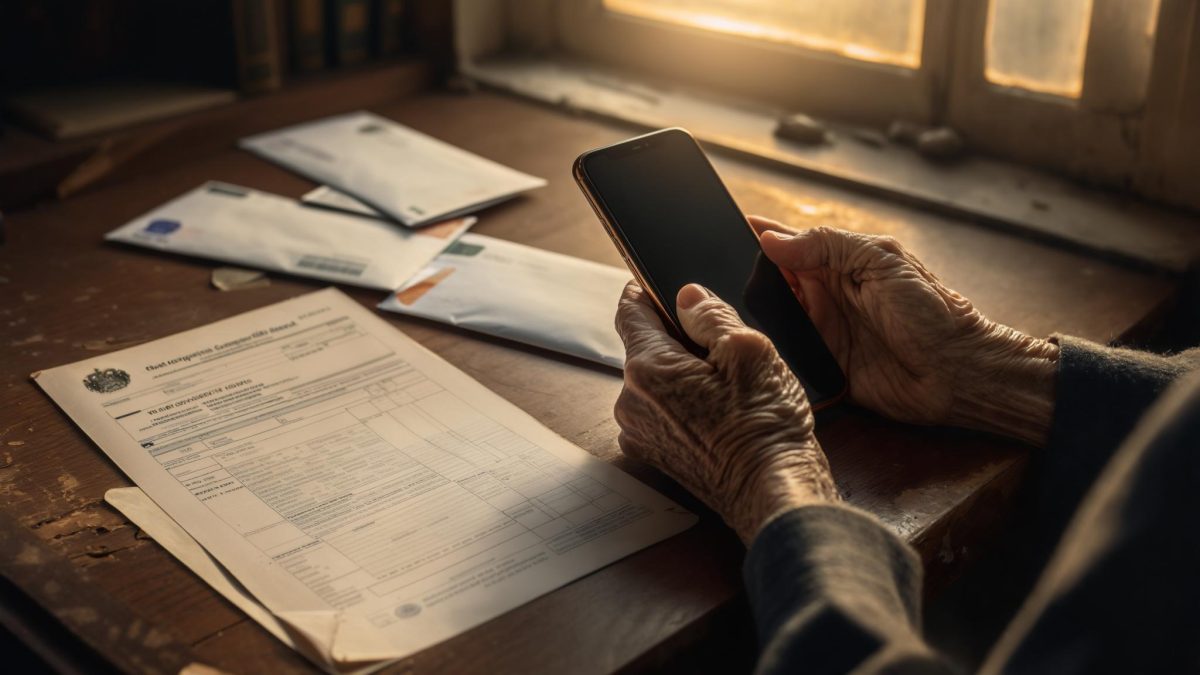
Roughly 2.4 million Americans receive Social Security overpayment notices each year, and millions more receive retroactive adjustments they never expected. For people living on tight margins, an unexplained deposit doesn’t feel like a gift — it feels like a trap.
I first heard about Lucille Holloway through a mutual friend at a neighborhood barbecue in late February. The friend, knowing I cover Social Security and government benefits, leaned over a folding table and said, quietly, “You need to hear what happened to Lucille.” Three days later, I was sitting across from Lucille at her kitchen table in Des Moines, Iowa, a cup of coffee going cold between us, as she walked me through one of the most disorienting financial experiences of her life.
A Widow’s Budget, Built on Precision
Lucille Holloway is 48, sharp, and deliberate with her words. She has worked as a union electrician for nearly two decades, but since her husband Raymond passed away from a heart attack in March 2022 at age 51, her financial picture has shifted considerably. She now receives Social Security survivor benefits based on Raymond’s work record — approximately $1,140 per month — alongside her own wages from part-time electrical work, which vary month to month.
Her two adult children, Marcus, 26, and Deja, 23, live out of state and both went through rough patches in 2024 and 2025. Lucille has been quietly wiring $300 to $400 a month between them. “I know I probably shouldn’t,” she told me, almost apologetically. “But they’re mine. I’m not going to watch them struggle when I can do something about it.”
After rent, utilities, groceries, her truck payment, and the money she sends south and east, Lucille said she finishes most months with somewhere between $80 and $150 left over. There is no cushion. Every line item is accounted for. Which is exactly why, on the morning of January 9, 2026, she noticed something that stopped her cold.
The Deposit That Started Everything
Lucille was checking her bank account on her phone before leaving for a job site when she saw it: a $312 deposit from the Social Security Administration, dated January 8. She had not applied for anything. She had not received any advance notice. Her regular benefit had already landed on January 3.
“My first thought was, this is a mistake,” she told me. “My second thought was, if it’s a mistake, they’re going to want it back.” She didn’t spend the money. She left it sitting in the account and called the SSA’s main line, 1-800-772-1213, where she waited on hold for over an hour before the call dropped.
Unexpected Social Security deposits can result from several legitimate causes: retroactive cost-of-living adjustments, corrections to prior payment calculations, or recalculations triggered by updated earnings records. According to a Social Security Q&A on JustAnswer, deposits in the $300 range frequently reflect retroactive COLA corrections or administrative recalculations — but recipients are rarely told in advance.
Lucille said she tried to find answers online and found threads full of people in similar situations, equally confused, equally worried. She decided to wait for a letter. One never came — at least not from the SSA. But something else arrived first.
The Phone Call She Almost Believed
Eight days after the deposit appeared, Lucille’s cell phone rang. The caller ID displayed a number she later confirmed was identical to the SSA’s official line. The man on the other end identified himself as an SSA representative and told her that her Social Security number had been “flagged for an unauthorized transaction” and that the $312 deposit was made in error. He said she needed to repay it immediately — and that an additional “processing fee” of $175 would be required to avoid suspension of her benefits.
“He knew things,” Lucille said, her voice careful. “He knew my name, he knew roughly what I received. I was shaken. He sounded official.” She asked for his employee ID number, and he gave her one without hesitation. He told her to purchase two prepaid Visa cards and call back with the numbers.
That detail made her pause. “I have a friend who works at a bank. She had told me once that if anyone ever asks you to pay with gift cards or prepaid cards, hang up. That was the only thing running through my head.” Lucille ended the call.
According to the SSA’s official scam awareness page, the agency will never call and demand immediate payment, threaten benefit suspension, or request payment via prepaid cards, gift cards, wire transfers, or cryptocurrency. The SSA also notes that scammers can spoof official SSA phone numbers — meaning the caller ID showing “1-800-772-1213” proves nothing about who is actually calling.
Getting Real Answers — Eventually
Over the following two weeks, Lucille made four separate attempts to reach the SSA. She eventually got through on a Tuesday morning after calling right when the office opened. A representative confirmed that the $312 deposit was legitimate — a retroactive adjustment tied to a recalculation of her survivor benefit based on updated earnings data Raymond had filed in 2021, which had only recently been processed.
It was not an overpayment. She owed nothing. The money was hers.
“I cried,” she told me, laughing softly at the memory. “I had been so stressed about it. I was terrified they were going to garnish my check or something. And it was just — it was mine the whole time.”
What the Experience Left Behind
The money was confirmed as legitimate. The scammer never called back. By any objective measure, Lucille’s story ended well. But when I pressed her on how the whole episode felt, she was honest about the toll it took.
Two weeks of anxiety. Four hours of hold time across multiple calls. The creeping fear that she would lose the survivor benefit she depends on every month. “I kept thinking — what if they had gotten me? What if I’d been older, or less suspicious?” she said. “That scammer knew exactly what he was doing. He called right when I was already confused.”
She still sends money to Marcus and Deja. The $312, once she confirmed it was hers, went to Deja to cover a car repair that had been sitting on a credit card for two months. Lucille didn’t mention that until the end of our conversation, almost as an afterthought. It struck me as entirely consistent with everything else she’d told me.
Social Security recipients across the country are navigating an environment where, as recent reporting on payment changes has made clear, legitimate shifts in benefit amounts are creating genuine confusion — and scammers have learned to exploit that confusion with precision. They call in the window between when a deposit appears and when a recipient can get a real answer. They use real-sounding numbers and real-sounding authority.
Lucille Holloway figured it out. But she was the first to tell me she got lucky. “I think about people who live alone and don’t have a friend who warned them about the gift cards,” she said, standing up to walk me to the door. “What happens to them?”
I didn’t have a good answer. That question stayed with me for the rest of the day.
Sloane Avery Wren is Senior Benefits Writer at Benefit Beat, covering Social Security, Medicare, and government benefits. If you have a story to share, reach out through the contact page.
Related: At 51, Bernice Castillo Pays $1,847 a Month for COBRA. Now She’s Racing the Clock to Social Security — If It’s Still There
Related: She Built a Spreadsheet for Her Mother’s Medicare Bills and Found $847 Missing From 5 Months of Social Security Payments
.pvv-faq-section details summary::-webkit-details-marker{display:none}.pvv-faq-section details summary::marker{display:none;content:””}.pvv-faq-section details[open] summary .pvv-faq-arrow{transform:rotate(90deg)}



Leave a Reply