

Most people assume that if you’ve worked hard for two decades, Social Security will have your back when it counts. That assumption, it turns out, can be dangerously wrong for millions of self-employed Americans — and Marlene Mendez is living proof of exactly how quietly that gap can grow.
I was introduced to Marlene in late February 2026 through Pastor Gilberto Reyes at Cornerstone Fellowship Church in Houston’s Third Ward. Pastor Reyes had mentioned her situation to me in passing after a Sunday service — he knew I covered government benefits for Benefit Beat, and he said, plainly, “This woman is working herself to the bone and she has no idea what’s waiting for her at the end of it.” Two days later, Marlene and I were sitting at a small folding table in the back of her barbershop on Almeda Road, the smell of clippers and pomade in the air, talking about numbers she’d never said out loud to anyone.
Twenty-Two Years Behind the Chair
Marlene Mendez, 53, has owned and operated her barbershop solo since 2004. She cuts hair six days a week, charges $22 for a standard cut, and on a good month clears around $2,800 after supplies and shop rent of $950. There is no HR department. There is no 401(k) match. There is no paid leave. It is just Marlene, her clippers, and a stream of regulars who’ve been coming to her for years.
She lives with a roommate in a rented house in Southeast Houston, splitting a $1,450 monthly rent. The house has a water heater that she described as “making sounds like a dying animal” and a roof section above the back bedroom that leaks every time it rains hard. She estimated the combined repairs at around $6,200 — money she doesn’t have and doesn’t see coming anytime soon.
Social Security had never been a priority conversation for Marlene. She knew it existed. She knew she paid into it — sort of. What she didn’t know was exactly how the self-employment tax system connects to her future monthly check, or that the way she’d filed (and some years, hadn’t filed) her taxes would matter this much.
The Number That Changed Everything
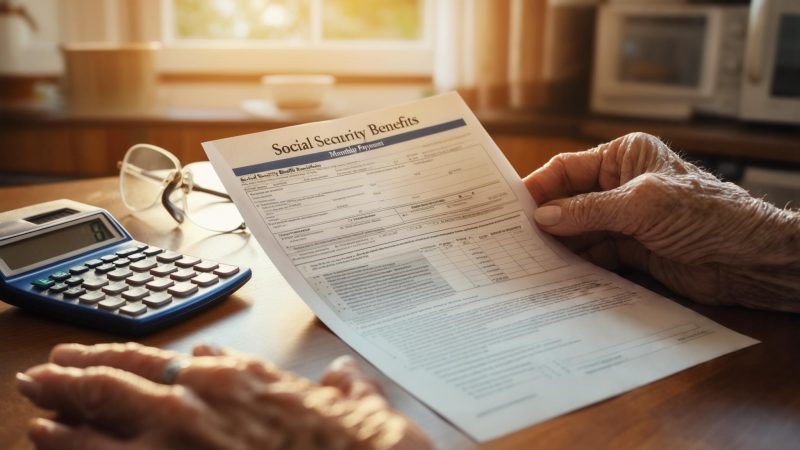
In January 2026, a client mentioned offhand that he’d just checked his Social Security account online. Marlene went home that night, created a My Social Security account at ssa.gov, and pulled up her earnings record for the first time in her life. What she saw made her set her phone down on the kitchen table and walk away from it.
Her projected monthly benefit at age 62 was $612. At her full retirement age of 67 — the threshold set by the Social Security Administration for anyone born in 1972 or later — the estimate climbed to $891. The national average monthly Social Security retirement benefit in early 2026 is approximately $1,976.
“I just kept staring at it,” Marlene told me. “I thought, I have been working since I was nineteen years old. How is this possible?” She wasn’t angry, exactly — it was more like the slow, heavy feeling of something you should have known landing all at once.
Where the Earnings Record Went Wrong
When I looked through what Marlene shared with me — her earnings record as shown on ssa.gov — the pattern was clear. Between 2004 and 2014, roughly ten years of her self-employment, at least six tax years showed zero or near-zero Social Security earnings. One year showed $1,100. Several showed nothing at all.
Marlene explained that in those early years, she was working with a tax preparer who told her she could reduce her tax bill by keeping her reported net income low. What nobody explained to her was that reported net self-employment income is exactly what the SSA uses to calculate your lifetime earnings record. Lower reported income means fewer Social Security credits and a smaller benefit calculation — permanently.
Self-employed workers pay the full 15.3% self-employment tax — 12.4% for Social Security and 2.9% for Medicare — on their net earnings, according to the IRS. That tax funds the credits that build the benefit. In 2026, one Social Security credit requires $1,810 in earnings, and workers can earn a maximum of four credits per year. You need 40 credits — ten years of work — to qualify for retirement benefits at all. Marlene has enough credits to qualify. Her problem isn’t eligibility. It’s that too many of her years show low or missing earnings in the calculation the SSA calls the Average Indexed Monthly Earnings, or AIME.
The Weight of What Can’t Be Undone
When I asked Marlene how she felt sitting with that information, she paused for a long moment before answering. “Tired,” she said. “I’m already tired. And now I find out I have to somehow fix something that I didn’t even know was broken.”
That exhaustion is real and it shapes everything. Marlene is not the kind of person who gives up — she’s kept a small business running through the 2008 recession, through COVID-19 shutdowns that cost her roughly four months of income in 2020, through a 2022 rent increase on her shop space that nearly pushed her out. But making plans and having the bandwidth to execute them are two different things, and at 53, working six-day weeks with no backup and a household budget that leaves little room, she described herself as “running on fumes most days.”
She has 14 years until full retirement age. She knows that. She also knows that those 14 years of properly reported self-employment income — assuming she continues filing accurately, as she has since switching tax preparers in 2019 — will start replacing some of those zero years in her 35-year calculation. Each clean year helps. But the math of what’s already baked in doesn’t change.
Small Moves, Long Timeline
After our first conversation, I connected Marlene with a nonprofit financial counselor at a Houston-area community organization — not to give advice, but to at least get her the information she’d been missing. When I checked back with her in March 2026, she had done two things: she’d called the SSA’s toll-free line to request a full earnings record printout, and she’d started setting aside $80 a month in a separate savings account she labeled, with characteristic practicality, “Old Marlene.”
“Eighty dollars isn’t going to save me,” Marlene told me, laughing a little. “But it’s something I can actually do right now. I can’t undo the past. I can’t go back and refile twenty years of taxes. What I can do is make sure the next fourteen years are clean.”
There’s a practicality to that framing that I found striking. She wasn’t optimistic in a performed way. She was just doing the next thing she could do, with the energy she had available.
What Marlene’s Story Tells Us About a Much Larger Problem
Marlene is not an outlier. The self-employed population in the United States is enormous — roughly 16 million people, according to Bureau of Labor Statistics estimates — and a significant share of them are in lower-income service trades where tax guidance is informal and income reporting is inconsistent. Barbers, house cleaners, food vendors, childcare providers: workers doing essential work with no benefits infrastructure around them.
The Social Security system wasn’t designed to fail them. But it also wasn’t designed with them actively in mind. The structure assumes consistent wage employment, W-2 income, and an employer handling withholding. For someone like Marlene, every piece of that infrastructure had to be self-managed — and she managed it without ever being told that the stakes of getting it wrong were her retirement security.
When I left Marlene’s shop that afternoon, she was already back behind the chair, cutting the hair of a teenager who’d come in with his grandfather. She worked quickly and carefully, the way she does everything. The water heater in her house was still making its sounds. The roof was still leaking. And her Social Security estimate was still $891 a month at 67 — not enough, not nearly, but something. She intends to make it more, fourteen years at a time.
Sloane Avery Wren is Senior Benefits Writer at Benefit Beat. This article is reported narrative journalism and does not constitute financial or legal advice. Readers facing similar situations are encouraged to contact the SSA directly at 1-800-772-1213 or visit ssa.gov.
(function(){var w=document.getElementById(‘pvv-scenario-s1775662005522o448’);if(!w)return;var btns=w.querySelectorAll(‘button[data-choice]’);btns.forEach(function(b){b.addEventListener(‘click’,function(){if(w.dataset.revealed)return;w.dataset.revealed=’1′;btns.forEach(function(x){x.style.opacity=x===b?’1′:’0.45′;x.style.cursor=’default’;x.style.transform=’none’});var o=document.getElementById(‘s1775662005522o448-out-‘+b.dataset.choice);if(o){o.style.display=’block’}});b.addEventListener(‘mouseenter’,function(){if(!w.dataset.revealed){b.style.borderColor=’#38bdf8′;b.style.transform=’translateX(4px)’}});b.addEventListener(‘mouseleave’,function(){if(!w.dataset.revealed){b.style.borderColor=’#334155′;b.style.transform=’none’}})})})();
.pvv-faq-section details summary::-webkit-details-marker{display:none}.pvv-faq-section details summary::marker{display:none;content:””}.pvv-faq-section details[open] summary .pvv-faq-arrow{transform:rotate(90deg)}



Leave a Reply