

Most people assume that a high salary is its own retirement plan. Earn enough, spend accordingly, and the future will sort itself out. James Okonkwo, a 41-year-old petroleum engineer in Houston, Texas, believed that for nearly two decades — until a slowdown in the oil market stripped away that certainty and left him staring at a Social Security statement he’d never thought to open before.
When I sat down with James Okonkwo at a coffee shop near the Energy Corridor in west Houston, he arrived in a pressed button-down and ordered an espresso without glancing at the menu. He carries himself with the confidence of someone who has always figured things out. But within the first ten minutes of our conversation, the composure shifted. He leaned forward, set down his cup, and said something that stayed with me long after we parted ways.
From Lagos to the Energy Corridor: A Rapid Climb
James immigrated from Nigeria at 19, enrolled at the University of Houston, and worked part-time jobs throughout his undergraduate years to cover tuition. He earned his engineering degree in 2007 and entered the oil and gas industry at a starting salary of roughly $62,000. By 2012, that number had climbed to over $130,000. By 2018, he was earning approximately $183,000 annually in base salary, plus bonuses.
With that income, James moved decisively. He purchased a primary home in the Katy suburb of Houston for $620,000 in 2017. Two years later, he bought a rental property in the Heights neighborhood for $410,000, then a second rental in Pearland for $310,000. Across three mortgages, his total debt load reached $1.2 million. He also committed to sending $800 per month to extended family in Lagos — a responsibility he described not as optional, but as cultural and personal obligation.
He told me that during those peak years, retirement felt theoretical. “I figured I’d outpace whatever Social Security gave me anyway,” he said. “I wasn’t thinking about those quarters I worked in college, or what the government was tracking. I was thinking about my next deal.”
When the Market Shifted, So Did Everything Else
Oil prices softened in late 2023 and extended into 2024 and 2025. James’s employer reduced billable hours for project engineers, and his effective take-home dropped to roughly $104,000 — a cut of nearly $80,000 from his peak earnings. The rental market in Houston also softened around the same period. His Heights property sat vacant for three months in early 2025, and the Pearland unit rented at $200 below his original projection.
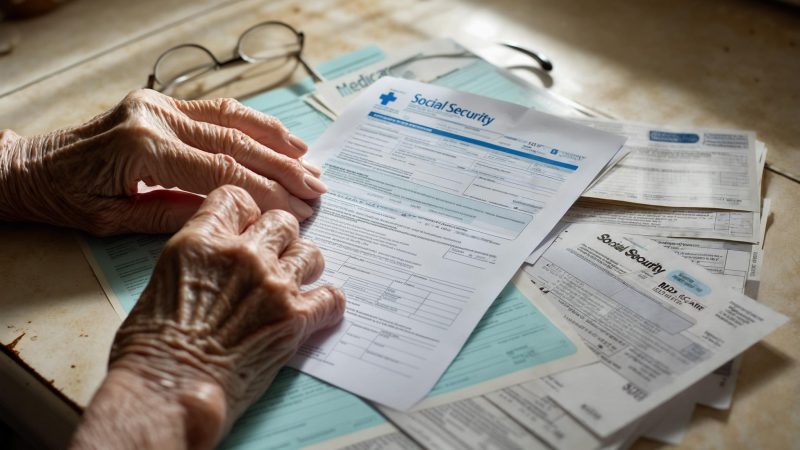
The fixed obligations, however, didn’t move. Three mortgage payments. The Lagos remittance. Insurance, property taxes, maintenance on two investment properties. James told me he began managing cash flow with a precision he hadn’t needed in years. That’s when he finally logged into his SSA.gov My Social Security account — not out of planning, but out of mild panic.
“I thought the number would be big,” James told me, the espresso now cold beside him. “I had been paying into this thing for over twenty years. I expected something substantial. What I saw was — not that.”
Reading the Statement: What the Numbers Actually Said
According to SSA’s benefit estimator, Social Security retirement benefits are based on a worker’s Average Indexed Monthly Earnings, calculated across the 35 highest-earning years of covered work. James began accumulating Social Security credits in the U.S. around 2001, meaning by age 41, he had roughly 24 years of covered earnings — leaving 11 years still to be filled, some of which the SSA would currently calculate as zeros when projecting benefits.
His projected monthly benefit at full retirement age — which for someone born in 1984 is 67 — showed approximately $3,100 per month in current dollars under the assumption he continued earning at recent reduced rates. At his peak salary, that number had been projected closer to $3,800. The difference wasn’t catastrophic in isolation. But James was looking at it against the backdrop of $1.2 million in debt and monthly obligations that left little room for accumulating separate retirement savings.
As James explained it to me, the statement wasn’t just a number — it was a mirror. “I had been telling myself that the properties were my retirement. But one of them is sitting mostly empty right now. The other one barely covers its mortgage. I had this mental picture of what my future looked like, and that picture was built on assumptions that had already stopped being true.”
The Part He Hadn’t Told His Wife
This was the moment in our conversation where James paused the longest. He’d been open about the debt figures, candid about the income drop. But when I asked about how his wife was processing all of this, his answer was quieter.
He told me she knew about the rental vacancies in general terms, but didn’t know the full picture of how tight cash flow had become. She didn’t know he’d logged into the Social Security portal at midnight on a Tuesday. “She knows things have slowed down. She doesn’t know I’ve been running the numbers every week for three months,” he said. “I’m working on that part.”
This isn’t an uncommon pattern. Financial therapists who work with high-earning professionals often describe what some call “success masking” — where visible markers of wealth (large home, investment properties, generous family support) obscure a fragile cash-flow structure underneath. James didn’t use that term, but he recognized the dynamic when I described it.
What He Did Next — and What He Wishes He’d Done Sooner
After reviewing his Social Security statement, James took a few concrete steps. He contacted the SSA to verify his earnings record was accurate, which it was. He noted that some of his part-time work in college had been cash-based and was never reported — meaning those years weren’t reflected in his record at all. He also learned that income from his rental properties, being passive rental income rather than self-employment income, does not contribute to Social Security earnings credits under current SSA rules on covered earnings.
“I always thought of Social Security as something for people who didn’t make much money,” James told me, and there was no arrogance in it — just an honest accounting of a belief he’d carried since arriving in the United States. “Now I understand it’s a floor. The question is whether I’ve built anything solid enough above that floor.”
As of March 2026, James has put one of his rental properties on the market. He hasn’t sold yet. He’s also begun a more direct conversation with his wife — not the full accounting, not yet, but what he described as “removing some of the fiction.” The Lagos remittances continue. He told me he wouldn’t change that.
The Reflection: Confidence Has a Cost
When I think about the people I’ve spoken with over the years who found themselves blindsided by benefits they’d underestimated or ignored, James fits a type I recognize — not the struggling worker who couldn’t afford to plan, but the successful one who believed planning was for people with less momentum. His story is specific to the oil and gas industry’s volatility, to immigration, to the weight of transnational family obligations. But the underlying dynamic is far more common.
Social Security is not just a safety net for low-income retirees. For a 41-year-old with $1.2 million in mortgage debt and a volatile income stream, a projected $3,100 monthly benefit at 67 could represent the most reliable income in his retirement picture — more reliable, potentially, than rental properties that depend on vacancy rates and market conditions.
James walked me to the parking lot after we finished, hands in his pockets. Before we said goodbye, he offered one last thought: “People like me come here and we work extremely hard. We believe in the upside of everything. Nobody tells you to also believe in the downside.” He said it without bitterness — more like someone filing a note for later use.
He has 26 years until his full retirement age. Whether those years unfold as a comeback story or a cautionary one is still being written. What changed, at least, is that he’s now reading the same draft the rest of the world has been looking at all along.
Related: The Social Security Claiming Age That Could Cost You $100,000 Over Your Lifetime



Leave a Reply