
The coffee shop on Southeast Division Street in Portland was still quiet when Grace Nakamura slid into the booth across from me, both hands wrapped around a ceramic mug. She smiled — warm, deliberate, the kind of calm you’d expect from someone who teaches breathing for a living. But within the first five minutes, the smile softened into something more complicated.
“I know what the right answer is supposed to be,” she told me. “Get a will. Get life insurance. Do the responsible thing. But we keep not doing it, and I think about it every single day.”
A Household Built on One Income — and a Lot of Trust
Grace, 38, spent nearly a decade in corporate human resources before walking away in 2021 to teach yoga part-time and grow a wellness blog she’d been running on weekends. She earns roughly $18,000 a year from classes and brand partnerships. Her partner, Derek, is a senior software engineer in Portland whose salary sits at $140,000. They have a seven-year-old daughter named Maren.
By most measures, the household functions well. But the financial architecture of it — one primary earner, one deeply dependent partner, a child, no life insurance, no disability coverage, no will — is a structure that the smallest catastrophe could collapse entirely.
What brought the topic into sharp focus for Grace wasn’t a doctor’s visit or a financial planner. It was a death. In November 2025, a friend of a friend — a 41-year-old father and freelance designer — died suddenly from a cardiac event. His wife, also self-employed, was left with two young children and no clear income path. “I heard about it through the neighborhood group,” Grace told me. “And I just sat there thinking — that’s us. That’s exactly us.”
What Social Security Survivor Benefits Actually Cover
Grace had spent years in HR and knew the basics of benefit administration — 401(k) vesting schedules, COBRA windows, PTO accrual. But she admitted to me she had never once thought about Social Security survivor benefits as something that applied to her family right now, at 38.
The reality is that Social Security isn’t only a retirement program. According to SSA’s survivors benefits page, when a worker who has paid into the system dies, their surviving spouse and dependent children may qualify for monthly payments — regardless of the worker’s age at death.
For a worker like Derek — in his early 40s, with years of high earnings on his record — the survivor benefit available to Grace and Maren would likely be substantial. But Grace had never checked. She had never created a my Social Security account to see what their projected numbers actually were.
“I just assumed it was something old people dealt with,” she said. “Retirement stuff. I didn’t know you could look up what you’d actually get if something happened tomorrow.”
The Philosophy Underneath the Anxiety
What makes Grace’s situation unusual — and, in my experience reporting on benefits, more common than people admit — is the tension between her stated values and her private fears. She genuinely believes, she told me, that material security is overemphasized in American culture. She and Derek have had real disagreements about money: he wants more savings buffers, she pushes back on what she calls “hoarding against hypotheticals.”
There’s a gap between what Grace believes philosophically and what she feels at 2 a.m. She described lying awake after hearing about the designer who died, running through scenarios. If Derek were gone tomorrow, her $18,000 income wouldn’t cover rent, let alone Maren’s school and health insurance. “I’d be completely dependent on the kindness of family,” she said quietly. “That’s not a plan. That’s just hope.”
What the Research Revealed — and What It Couldn’t Fix
After our initial conversation, Grace told me she spent an evening on SSA.gov for the first time. She created a my Social Security account and looked up Derek’s projected benefit numbers. What she found both reassured and unsettled her.
Based on Derek’s earnings history, the estimated survivor benefit available to Grace — as a surviving spouse caring for a child under 16 — would be a meaningful monthly payment. She didn’t share the exact figure with me, but described it as “more than I expected, and still not enough to live on here.” Portland’s cost of living is high; a Social Security benefit alone, without any savings or life insurance, would require significant lifestyle changes.
That detail — the “blackout period” — was new information for Grace. She hadn’t known that survivor benefits for a young spouse pause once the child ages out of eligibility. “So I’d have coverage while Maren is little, and then nothing until I’m 60,” she said when I explained it. “That’s a 20-year window where I’m on my own entirely.”
The disability angle hit differently. Because Grace left corporate work in 2021 and now earns $18,000 a year, her own Social Security work record has thinned considerably. If she were to become disabled, her SSDI benefit — calculated from her own lifetime earnings — would be far smaller than Derek’s. “I basically cashed out my earning record to do something I love,” she said. “I don’t regret it. I just didn’t think about what that meant for this stuff.”
A Partial Reckoning, Not a Clean Ending
I want to be honest about where Grace’s story lands, because it doesn’t resolve the way these stories sometimes do in personal finance media. She hasn’t gotten life insurance. She and Derek still haven’t seen an estate planning attorney. When I followed up with her in late March 2026, she told me they had one preliminary conversation about a will and then let it drop again.
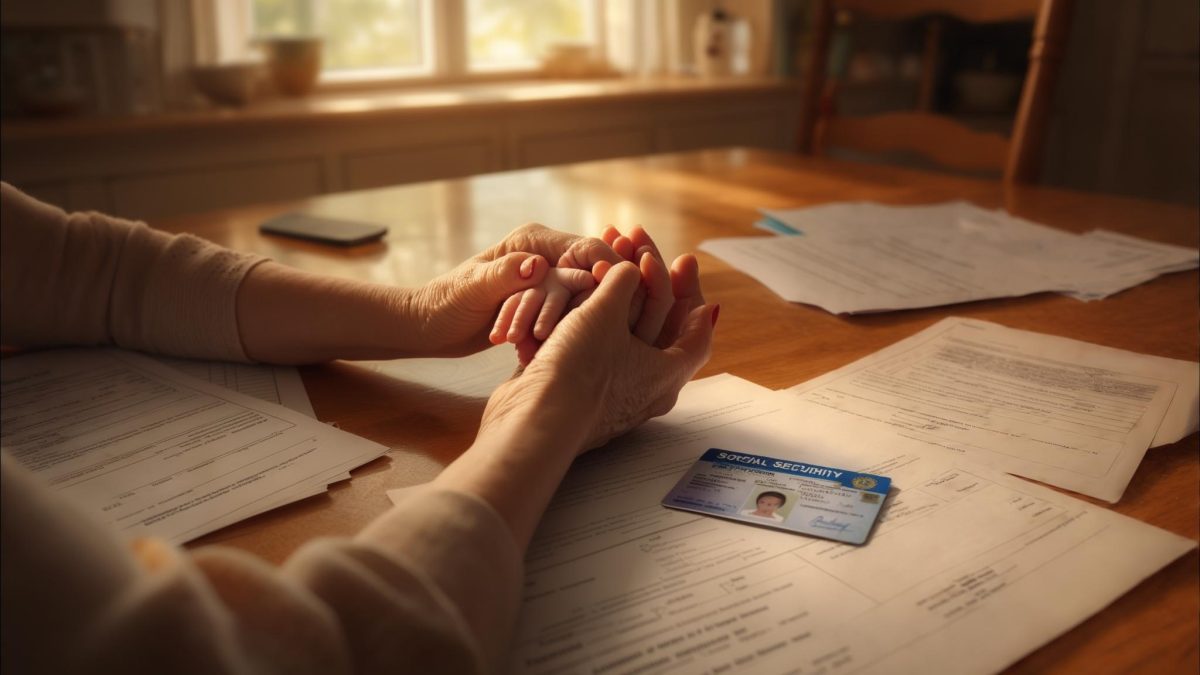
What changed, concretely, is that Grace now knows what the Social Security system would and would not provide. She printed out a benefits estimate from her my Social Security account and put it on their kitchen bulletin board — next to Maren’s school calendar and a grocery list. “I wanted Derek to see the actual number,” she said. “Not me worrying out loud. The actual number.”
Sitting across from Grace that morning, I kept thinking about how many households look roughly like hers — asymmetric incomes, unconventional careers, values that don’t always map neatly onto conventional financial planning. The Social Security system was built partly for exactly this kind of vulnerability. Whether it’s enough is a different question. But knowing it exists, knowing its actual shape, is a starting point that Grace told me she wishes she’d reached years earlier.
“I feel less like I’m just hoping,” she said, finally. “At least now I know what we’re actually working with.”
Related: Up to 85% of Your Social Security Can Be Taxed and Most Retirees Don’t Find Out Until It’s Too Late




Leave a Reply