

The application of Social Security survivor benefits is, on its surface, straightforward. A spouse dies. The surviving partner files a claim. A monthly check arrives. That is the version of the story most people carry around in their heads — and for millions of older widows and widowers, it holds true. But for younger survivors without minor children at home, the system works very differently. The gap in eligibility has a name: the blackout period. And most people don’t learn about it until they’re already in it.
Joanne LaRoche learned about it on a Tuesday morning in December 2024, sitting in a plastic chair at an SSA field office on the east side of Indianapolis. She was 33 years old. Her husband, Marcus, had been dead for two months.
How I Found Joanne — and Why Her Story Matters
A social worker at the Marion County Assistance Office mentioned Joanne’s name to me in late January 2026. “She came in looking for anything that could help,” the worker told me. “She’s one of those people who doesn’t ask, but she needed to.” I reached out through a community outreach program the office coordinates, and Joanne agreed to talk over coffee near the elementary school where she works as a custodian.
When I sat down with Joanne LaRoche at a diner on East 38th Street, the first thing I noticed was how composed she was. She had the posture of someone who had decided, somewhere along the way, that falling apart was not an option. She talked about Marcus — 36 when he died, a delivery route driver who had worked steadily for over a decade — the way people talk about someone whose absence still doesn’t feel entirely real.
“I went to that SSA office thinking I was going to walk out with a plan,” Joanne told me. “I didn’t even know what questions to ask. I just knew that Marcus had worked his whole life and paid into the system, and I thought that meant something for me right now.”
The Financial Situation Joanne Was Dealing With
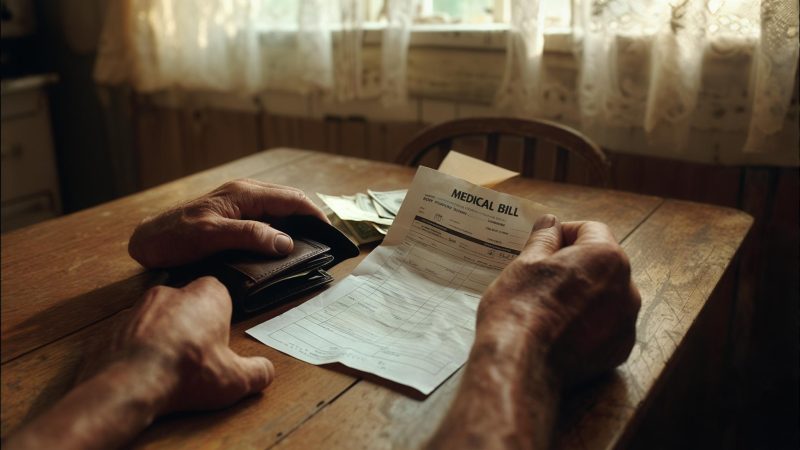
Marcus died on October 12, 2024, after a short illness that his doctors initially misread as a respiratory infection. He was uninsured at the time of his hospitalization. The medical bills that followed his death totaled just over $14,000, most of which Joanne said she was still trying to navigate through the hospital’s charity care process when we spoke.
Joanne earns approximately $36,200 per year as a full-time custodian with Indianapolis Public Schools. The job doesn’t come with employer-sponsored health insurance, so she pays $338 per month for a marketplace plan through the ACA Marketplace — a cost she described as “one of the things that keeps me awake.” She also owes $4,800 more on her 2019 Kia than the car is currently worth.
Her two adult children — a daughter, 19, and a son, 21 — live out of state and are largely self-supporting, though Joanne said she still helps when she can. Marcus had children from a previous relationship, and his ex had been ordered to pay child support for years, though Joanne said those payments had been irregular at best.
What the SSA Field Office Told Her — and What It Meant
Joanne filed for survivor benefits in November 2024, about three weeks after Marcus died. She had gathered everything she thought she would need: their marriage certificate, Marcus’s Social Security number, his death certificate, proof of her own identity. The SSA representative she spoke with in December was, by Joanne’s account, thorough and not unkind. But what the woman explained left Joanne sitting very still for a long moment.
Because Joanne is 33 and has no dependent children under 16 living at home, she does not qualify for survivor benefits now. Under SSA survivor benefit rules, a widow without qualifying dependents cannot collect reduced survivor benefits until age 60, or full survivor benefits until her full retirement age — currently 67 for those born after 1960. The period between when dependent children age out of eligibility and the widow’s 60th birthday is known informally as the blackout period.
For Joanne, that gap runs from today until roughly 2053. Twenty-seven years.
The SSA representative did tell Joanne that based on Marcus’s earnings record, her estimated survivor benefit at age 60 would be approximately $1,090 per month — reduced because she would be claiming before full retirement age. At 67, that figure rises to around $1,380. But those numbers exist in a future that Joanne, facing an underwater car loan and medical debt in 2025, could not easily hold onto.
What Joanne Did Next — and What She Was Left With
After leaving the SSA office in December 2024, Joanne said she spent about two weeks in what she described as a fog. She went to work. She called her daughter on Sundays. She did not tell her children the full picture of her finances because, as she put it, “they have their own things going on, and I’m not going to put that on them.”
In January 2025, at the suggestion of a coworker, she contacted a local nonprofit that provides benefits counseling at no cost. Through that process, she was screened for Indiana’s Medicaid program — she did not qualify due to her income — and for a premium tax credit adjustment on her marketplace plan, which reduced her monthly premium slightly from $338 to $291. She also learned she might qualify for the Indiana Telephone Assistance Program and a utility assistance program through her county.
“I’m piecing things together,” Joanne told me. “It’s not a solution. It’s more like plugging small holes in a boat that has a big hole in the bottom.”
There was one more door that opened, partially. Marcus’s children from his previous relationship — who are minors — were found to potentially qualify for Social Security survivor benefits based on his earnings record, separate from Joanne’s own claim. That determination would depend on their mother filing on their behalf. Whether that happens, Joanne said, is not something she has any control over.
The Quiet Math of Getting By
When I asked Joanne how she thinks about the next few years financially, she was quiet for a moment before answering. She said she had started picking up a Saturday morning cleaning shift at a private facility near her neighborhood — an extra $180 to $220 per month, depending on the week. She is also, she said, trying to pay down the car loan aggressively enough to get above water before the vehicle needs major repairs.
She does not expect help from Social Security anytime soon. What she does have, she told me, is the knowledge that Marcus’s record is sitting there — building, in a sense, a benefit she will eventually be able to access. According to the SSA’s survivor benefits overview, the amount she would receive at 60 is based on what Marcus had earned over his lifetime, which means his decade-plus of steady work does have lasting value for her — just not yet.
The comparison between what older and younger widows receive from Social Security is stark, and it points to a structural tension in how the survivor benefit program was designed — largely in an era when widows were expected to either have dependent children or be close to retirement age themselves.
What Joanne’s Story Reveals About a Gap in the System
Joanne is not an outlier. The Social Security Administration does not publish a specific count of individuals currently in the blackout period, but researchers at the Urban Institute and other policy organizations have noted for years that the survivor benefit structure disproportionately affects younger widows — particularly those in working-class jobs without employer-sponsored retirement plans or life insurance.
Joanne told me she wished someone had explained this to her before Marcus died — not because it would have changed anything, but because she would have thought differently about life insurance, about savings, about what a safety net actually looks like when you’re 33 and everything falls apart at once.
“I’m not angry at the system, exactly,” she said, folding her hands around a coffee mug that had gone cold. “I’m just tired of finding out how things work after the thing has already happened to me.”
I left the diner that morning thinking about the distance between what people believe the government safety net provides and what it actually does — and how rarely those two things match at the exact moment someone needs them to. Joanne LaRoche is doing what she has always done: putting one foot in front of the other, working her Saturday shifts, waiting for a benefit that is hers by record but not yet by check. Whether the system should work this way is a question that extends well beyond her story. But her story is a precise and human illustration of the answer.
Related: The $14,000 Loan She Cosigned Destroyed Her Path to Social Security at 62



Leave a Reply