
What would you do if the safety net you paid into for decades turned out to have holes you never knew were there? That question sat with me for days after I first connected with Sonia Chen-Ramirez, a 54-year-old auto mechanic and shop owner from El Paso, Texas, who found out the answer the hard way.
I came across Sonia in a Facebook group called “Social Security & Retirement Help — Real Talk,” which has roughly 47,000 members. She had posted a short, plainly worded message in late January 2026 asking whether SSDI could be garnished by a debt collector. The responses she got were conflicting, some outright wrong. I sent her a direct message asking if she’d be willing to talk. She replied within an hour: “Sure. Not like I’m going anywhere. My back won’t let me.”
Twenty-Six Years Under the Hood
When I spoke with Sonia Chen-Ramirez over a video call on a Tuesday afternoon in February 2026, she was sitting in the small office attached to her shop, Chen-Ramirez Auto, which she has owned since 2011. The lift was idle behind her. The shop, which usually serves about 30 to 40 customers a week, had been running on one employee since October 2025 — the month Sonia stopped being able to work full days.
The injury happened on September 4, 2025. She was pulling a transmission on a 2019 Ford F-250 when she felt something give way in her lower back. “It wasn’t dramatic,” she told me. “No pop, no fall. I just couldn’t straighten up after.” An MRI the following week confirmed two herniated discs at L4-L5 and L5-S1, with nerve compression on the right side.
Because Sonia owns the shop, her workers compensation situation was complicated from the start. In Texas, according to the Texas Department of Insurance, private employers are not required to carry workers comp coverage — and Sonia had opted out years earlier to save on premiums, a decision she described to me with flat, tired candor. “I thought I was being smart about overhead. I was wrong.”
She had filed a claim anyway through a liability policy she carried on the business, but it was denied in November 2025. The insurer’s position was that the injury was a pre-existing degenerative condition, not an acute workplace event. Sonia is contesting that denial with the help of a personal injury attorney, but the process is slow and she is not receiving any income from it yet.
The SSDI Question — and What She Didn’t Know
With no workers comp income and her shop running at reduced capacity, Sonia began researching SSDI in December 2025. She had paid into Social Security consistently since age 18 — she estimates she has more than 140 work credits, well above the 40 credits required for SSDI eligibility.
She filed her SSDI application online through the Social Security Administration on January 8, 2026. Her estimated projected benefit, based on her earnings record, was approximately $1,480 per month. She was told to expect an initial decision within three to six months.
“I did the math,” Sonia told me. “Even if I get approved tomorrow, I don’t see a check until June at the earliest because of the waiting period. That’s six months I have to survive on almost nothing.” The five-month mandatory waiting period — a rule baked into federal law — means SSDI benefits cannot begin until the sixth full month of disability, regardless of when the application is approved.
The Garnishment Threat That Brought Her to Facebook
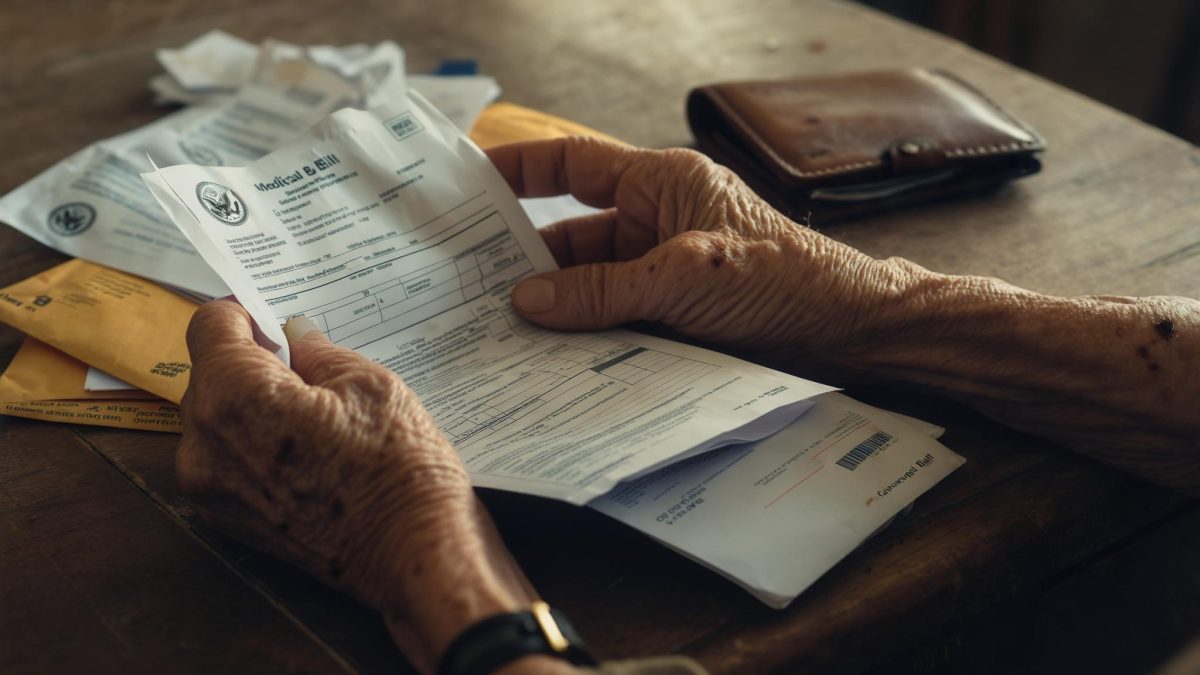
The Facebook post that led me to Sonia was not primarily about SSDI. It was about fear. She had received a letter in January 2026 from a debt collection agency referencing an unpaid balance of $6,840 — the remnant of an emergency room visit in 2022 when she underwent an appendectomy and her insurance covered only part of the bill. The debt had been sold twice. The letter contained language suggesting the collector could pursue garnishment of federal benefits.
“I panicked,” she told me. “I thought, if I finally get SSDI approved and these people can just take it, what’s the point?”
The private medical debt, as Sonia eventually confirmed through a legal aid clinic in El Paso, could not be used to garnish her SSDI or Social Security benefits. But there was a second collection matter — an old personal loan from a credit union that had obtained a judgment against her in 2021. A judgment creditor in Texas, depending on the account type, may have more limited options than in some other states, but the threat felt real to her. She was already paying approximately $620 per month in child support for her two children, ages 12 and 15, and child support obligations can be enforced against Social Security income.
“Nobody told me child support could come out of a disability check,” she said. “I assumed it was protected. It’s not. That was a rough thing to find out.”
What the Numbers Actually Look Like
As Sonia explained her situation to me, the arithmetic was stark. If her SSDI application is approved and she begins receiving approximately $1,480 per month, her child support obligation of $620 would reduce that to roughly $860 before any other expenses. Her monthly rent on the house she leases alone is $975.
The shortfall is not theoretical. Sonia has been drawing down a savings account that held about $11,000 at the start of 2026. By the time we spoke in February, it was closer to $7,200. She has also accumulated approximately $4,100 in credit card debt since October 2025 — groceries, a car repair on her personal vehicle, two co-pays for specialist visits related to her back injury.
What She Wishes She Had Known
Sonia is not someone who dwells in regret for long — she said as much herself — but there were moments in our conversation where exhaustion overtook practicality. She told me she wished she had understood the gap between when an injury occurs and when federal disability income can begin. She also wishes she had carried workers comp on her own shop, even as the owner.
“I built something,” she said, gesturing toward the bay behind her. “I did it myself, no help from anyone. And now I’m filling out government forms and praying some reviewer in Baltimore decides my MRI is bad enough. That’s a strange place to be.”
One thing she has since learned — through the legal aid clinic and her own research on the SSA’s garnishment guidelines — is that if her SSDI is direct-deposited into a bank account, two months’ worth of benefits are generally protected from private creditor levies under federal law. She found that small detail clarifying, if cold comfort.
There is also the matter of Medicare. If her SSDI is approved, Sonia would become eligible for Medicare — but not immediately. Federal law requires a 24-month waiting period after SSDI benefits begin before Medicare coverage kicks in. Given her back condition requires ongoing specialist care, that gap is not an abstraction. She has been rationing physical therapy appointments because her current health plan, a high-deductible plan through the Texas marketplace, has a $4,500 deductible she has not yet met this year.
When I asked how she was managing emotionally, she paused before answering. “I make a list every Sunday of what I have to do that week,” she said. “Doctor. Lawyer. SSA portal check. Sometimes I don’t do half of it because I just don’t have the energy. Then I feel guilty. Then I make another list.” She said it with a dry, tired laugh that carried no self-pity — just recognition.
As of the time of publication, Sonia’s SSDI application remains pending. Her workers comp appeal has a hearing scheduled for May 2026. She has retained the one employee at her shop and is covering his wages, barely, through her remaining savings. She has not missed a child support payment. That, she told me at the end of our call, was the thing she was most determined to protect. “Whatever else falls apart,” she said, “those kids get paid.”
I thought about Sonia’s Sunday lists for a long time after we hung up. The systems that were supposed to catch people like her — workers comp, disability insurance, medical debt protections — each had a gap, a delay, or a fine print carve-out. She had done everything asked of her: worked, paid in, stayed current on her obligations. The gap between doing the right things and being protected from catastrophe turned out to be wider than she had imagined.


Leave a Reply