
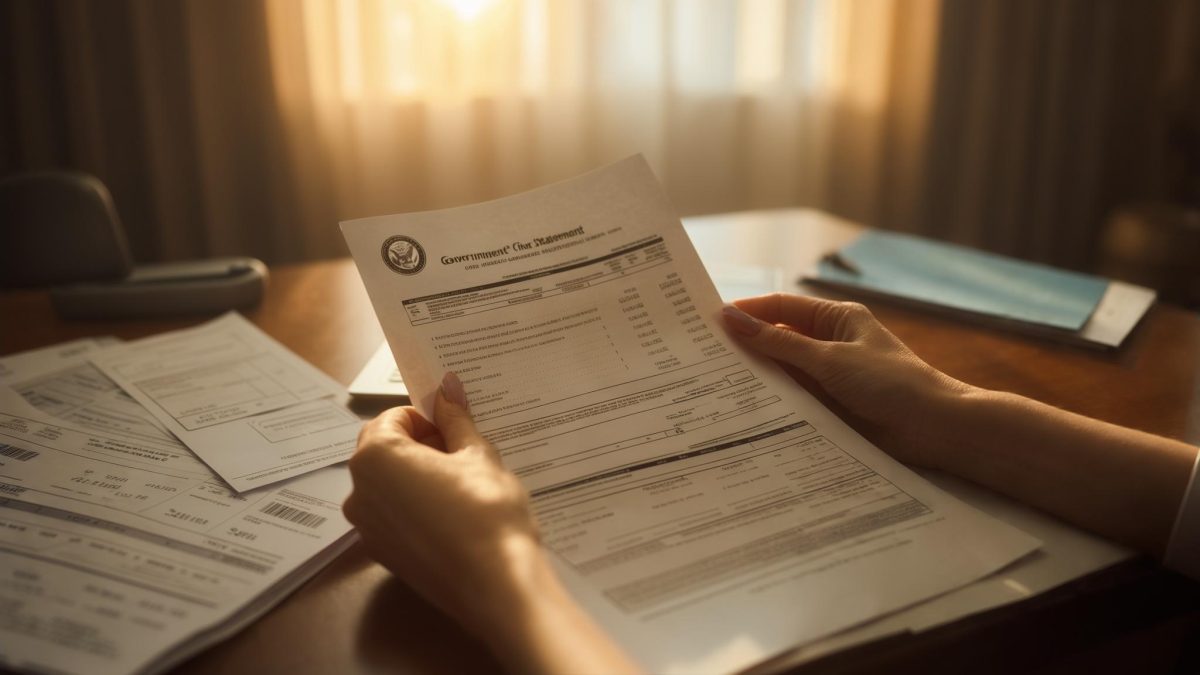
Have you ever looked at a government document and realized it was telling you something about your financial future that you had never once thought to ask about?
That was Marian Ochoa’s experience last October, sitting at a break-room table during a split shift at the Doubletree in downtown Little Rock, scrolling through her Social Security statement on her phone for the very first time. She was 34 years old. She had been working since she was 17. And she had never once checked that statement before.
I first heard about Marian through David Pruitt, a consumer lending manager at a local credit union branch off Cantrell Road. Pruitt told me that Marian had come in asking about hardship loan options to cover a failing HVAC unit in the home she rents with a roommate — a repair that the landlord had made clear was her financial responsibility under the lease. While reviewing her overall financial picture, Pruitt noticed something and suggested she talk to me. He thought her story was worth telling. He was right.
A Good Job With a Moving Target for a Paycheck
When I sat down with Marian Ochoa at a coffee shop near the hotel, she arrived with a yellow legal pad covered in her own notes — budgets, projections, questions she had written down. She described herself as someone who likes to understand systems. The problem, she told me, was that her income had never been simple enough to fit a system.
Marian earns a base wage of roughly $19.50 an hour as a front desk manager, which translates to approximately $40,600 annually before anything else. But her actual take-home varies significantly. In a strong quarter — holiday bookings, conventions, high occupancy — she picks up overtime and occasional performance bonuses that push her annual income toward $62,000 or higher. In slower stretches, she has cleared as little as $47,000. She has no dependents and lives with a roommate to manage costs, but her rent, a personal loan she took out in 2022, and the now-urgent HVAC repair have left her with almost no financial buffer.
The statement she pulled up through the SSA’s My Social Security portal showed her complete earnings record going back to her first W-2 job at 17. Most years looked reasonable. But three years — 2019, 2020, and 2021 — showed dramatically reduced or near-zero reported earnings. During that stretch, she had worked as a 1099 contractor doing event coordination for a hospitality staffing agency, a common arrangement in the hotel industry. She had paid self-employment taxes, she believed. But when she looked at the record, those years had been underreported, and one year showed earnings of just $4,100.
What the Social Security Statement Actually Showed Her
The Social Security earnings statement is not complicated to read, but its implications take a moment to absorb. According to SSA’s official guidance, your future retirement benefit is calculated using your 35 highest-earning years. If you have fewer than 35 years of earnings on record, the SSA fills in the remaining years with zeros — which pulls the average down and reduces your monthly benefit.
At 34, Marian had 17 years of recorded earnings. That means she still had 18 years ahead of her to build her record. But three of her existing years were so low they functioned almost like zeros in the calculation. The projected monthly benefit listed on her statement — assuming she continued earning at her current pace until age 67 — was approximately $1,580 per month in today’s dollars.
She showed me the statement herself at our meeting, rotating her phone so I could read the column of figures. The year 2020 listed $4,100. The year 2021 listed $6,800. “I worked constantly those years,” she told me, her voice flat with a particular kind of exhaustion that comes from doing the right thing and still coming up short. “I was picking up every shift I could. I thought I was building something.”
How Irregular Income Creates Invisible Gaps in a Benefits Record
This is a structural problem that affects a large share of hospitality and service industry workers, and Marian’s case is far from unusual. When workers transition between W-2 employment and 1099 contractor arrangements — as commonly happens in hotel staffing, catering, and event coordination — their earnings can fall through the cracks if self-employment taxes are not filed correctly or if quarterly estimated payments are not properly attributed.
Marian said she had used a tax preparer during those years but never followed up to confirm what had actually been reported to the SSA. She assumed the process was automatic. As she explained it to me: “Nobody ever tells you to go check. You file your taxes, you get your refund or you pay what you owe, and you assume it all went where it was supposed to go.”
According to the Social Security Administration, workers can request a correction to their earnings record by contacting the SSA directly and providing documentation — typically W-2s, 1099s, or tax transcripts — to verify the disputed years. The process is not automatic and requires the worker to initiate it.
The Outcome — Partial, and Still Unresolved
When I followed up with Marian in late February 2026, her case was still open with the SSA. One of the three disputed years — 2021 — had been corrected, adding approximately $6,200 in earnings back to her record. The other two years remained under review because the documentation from the staffing agency was incomplete.
“I have no idea how long this takes,” she told me by phone. “I submitted everything I had in November. I’m just waiting.” She said the correction to the 2021 year had bumped her projected benefit by roughly $40 per month at age 67 — a number that sounds modest until you multiply it across a 20-year retirement. Over that horizon, it represents approximately $9,600.
The HVAC unit was replaced in January, financed through a $3,800 personal loan at 11.9% APR — not what Marian had hoped for, but the credit union helped her find a workable term. The immediate financial pressure eased somewhat. But she told me the Social Security discovery had shaken something loose in how she thinks about her work history.
She has since set a calendar reminder to check her SSA statement every January. She also said she plans to switch to a CPA for her taxes going forward, specifically to have someone who can verify that self-employment income is being properly reported to the SSA, not just to the IRS.
What Marian’s Story Points to for Other Young Workers
Marian Ochoa is not a cautionary tale about irresponsibility. She paid her taxes. She worked hard through a pandemic. She never ignored a bill. She simply did not know to look at a document that most people under 40 have never opened — a document that has been quietly tracking their financial future since their first paycheck.
The hospitality industry runs heavily on gig arrangements, shift trades, and contractor relationships. So do retail, healthcare support, freelance media, and dozens of other sectors where workers in their 20s and 30s are building their careers. In all of those fields, the gap between what gets paid and what gets properly credited to a Social Security record can be substantial — and it compounds quietly over decades.
When I left the coffee shop after our first meeting, Marian was already back on her phone, pulling up IRS.gov to start the transcript request process. She had her legal pad in her lap and a pen behind her ear. The scale of what she was dealing with — the debt, the repair, the incomplete records, the bureaucratic wait — was real and unresolved. But she was moving through it with the deliberate focus of someone who had found a problem she could actually name. That, at least, was something.
Her case is still open. The correction for 2019 and 2020 may or may not come through. Thirty-three more years of earnings still lie ahead of her. What those years look like — and whether the record will reflect them accurately — depends in part on choices she makes now that she knows to make them.




Leave a Reply