
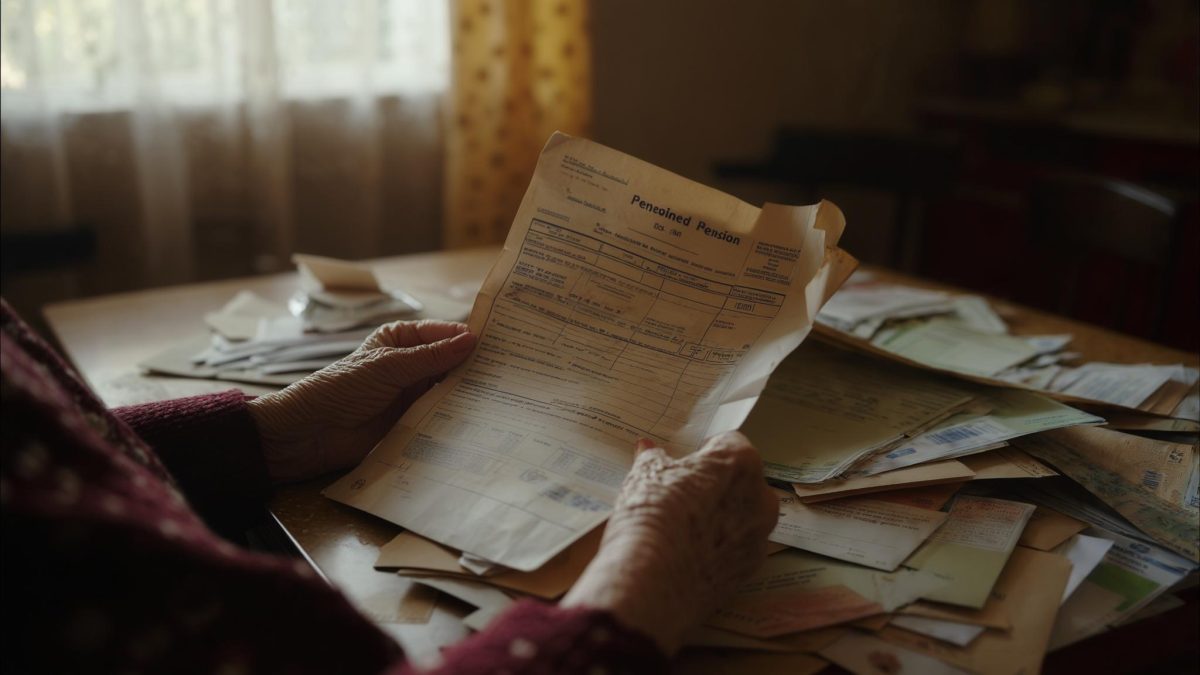
The kitchen table at Patricia Novak’s Pittsburgh home is covered in coupons. Not casually — methodically. They’re sorted by store, clipped with precision, rubber-banded in groups. When I arrived on a Tuesday morning in late March, she was already dressed, coffee made, ready to talk. She apologized for the cold in the living room before I even sat down. “The furnace has been struggling,” she said. “I keep it at 64 and wear extra layers.”
Patricia is 65. She retired from the United States Postal Service after 32 years. By any measure, she did everything right — worked a union job, earned a pension, stayed in the same Pittsburgh house she and her husband bought in 1987. But when I asked how she was really doing financially, the pride in her face shifted into something quieter.
“I’m managing,” she said carefully. “That’s the word I use. Managing.”
The Math That Stopped Adding Up After Her Husband Died
Three years ago, Patricia’s husband, Gerald, died after a brief illness. He had worked in manufacturing for most of his career and received a Social Security retirement benefit of roughly $1,650 per month. When he was alive, the two of them had a combined monthly income that — while not comfortable — covered the basics and left a small cushion.
After Gerald died, that cushion vanished. Patricia told me she was left with her USPS pension of approximately $1,380 per month and her own Social Security benefit. But the survivor benefit she expected to receive from Gerald’s record was far less than she had anticipated.
Patricia’s home, a two-story colonial built in the 1960s, now needs a new roof — estimates she’s received run between $9,500 and $12,000. The furnace is another $4,200 to $5,000 to replace. Her savings, she explained, are deliberately untouched: she’s earmarked them for medical expenses, knowing that one hospitalization could erase years of careful living.
So she drives 20 minutes to a discount grocery store twice a week. She clips coupons. She wears extra layers indoors in March. And she has not called her adult children to ask for help — a point she raised without my asking, with a firmness that made clear it was non-negotiable.
The Rule That Quietly Cut Her Benefits for Decades
What happened to Patricia’s survivor benefit has a name: the Government Pension Offset, or GPO. For decades, this provision of Social Security law reduced — or entirely eliminated — spousal and survivor benefits for people who also received a pension from a government job not covered by Social Security taxes. USPS employees hired before 1984 fell under this rule.
The formula was unforgiving. Under the GPO, a retiree’s spousal or survivor Social Security benefit was reduced by two-thirds of their government pension. Patricia’s USPS pension of roughly $1,380 per month meant a reduction of about $920. Applied to the survivor benefit she should have received — approximately $1,320 per month based on Gerald’s record — that left her with roughly $400 per month from his Social Security.
A related provision, the Windfall Elimination Provision (WEP), also reduced Patricia’s own Social Security retirement benefit. Workers who receive pensions from jobs not covered by Social Security — and also qualify for Social Security based on other work — have their benefit calculated using a modified formula that typically results in a lower monthly payment.
Patricia told me she had no idea either provision existed when she retired in 2020. She said her union had mentioned something about Social Security being complicated for government workers, but the specifics were never spelled out for her in a way that registered. “You plan based on what you think you’re going to get,” she said. “And then you get something different.”
When the Law Changed — and What Patricia Learned About It From Her Daughter
On January 5, 2025, President Biden signed the Social Security Fairness Act into law. The legislation eliminated both the WEP and the GPO, effective for benefits payable after December 2023. For the roughly 3.2 million Americans affected, including an estimated 735,000 impacted by the GPO, it meant retroactive adjustments and increased monthly payments going forward.
Patricia did not learn about the law from the Social Security Administration. She learned about it from her daughter, who texted her a news article in January 2025.
The SSA confirmed to Patricia that she was eligible for recalculation under the new law. The process took several months — she described receiving conflicting letters, one saying her case was under review and another appearing to show no change. When her adjusted payment finally arrived in the summer of 2025, it included a lump-sum retroactive payment covering the months going back to January 2024.
Patricia said the retroactive payment was meaningful — she used part of it to get her furnace serviced and to cover a medical copay she had been putting off. But she was also measured about what it changed. “It helped,” she told me. “It didn’t fix everything. It helped.”
The Numbers Now, and What Remains Out of Reach
With the GPO and WEP eliminated, Patricia’s monthly income shifted. Her survivor benefit from Gerald’s record rose from roughly $400 to approximately $1,320 per month. Her own Social Security payment also increased under the revised WEP calculation. Combined with her pension, she now brings in approximately $3,300 to $3,400 per month, depending on the month and any Medicare premium adjustments.
That is more than before. It is still not enough for the roof.
The roof, Patricia explained, is now actively leaking in one corner of the second floor. She has a contractor’s tarp and a bucket system. She is looking into whether any county programs in Allegheny County offer home repair assistance for senior homeowners on fixed incomes, and a neighbor mentioned something about a HUD-backed program. She has not yet applied for anything.
The 2025 COLA increase of 2.5 percent, announced by the Social Security Administration in October 2024, added a modest amount to Patricia’s monthly benefit. She noticed it. She also noticed that her Medicare Part B premium increased at roughly the same time, partially offsetting the gain. “They give with one hand,” she said, without bitterness, just matter-of-factly.
What Patricia’s Story Reveals About a Systemic Gap
When I left Patricia’s house that Tuesday, I drove past the corner where her mail route used to end — she pointed it out when I arrived. Thirty-two years on that route. Thirty-two years of getting up before dawn in Pittsburgh winters, delivering mail rain or shine, building toward a retirement that was supposed to be stable.
The GPO and WEP affected millions of public sector workers — teachers, firefighters, postal workers — who often discovered the provisions only at the worst possible moment: after a spouse died, or when they finally opened that first benefit letter. The Social Security Fairness Act addressed the legal inequity. It did not return the years of reduced income, or rebuild the savings that were depleted in the meantime.
Patricia is glad the law changed. She is also clear-eyed about what it did not change. She still clips coupons. She still keeps her thermostat at 64 degrees. She still has a bucket on the second floor catching water when it rains.
“I don’t regret my career,” she told me as I was putting on my coat. “I’d do it again. I just wish someone had sat me down at 55 and said, here’s what your retirement is actually going to look like. Here’s what to expect. Because nobody did that. Nobody did that at all.”
She walked me to the door, pointed at the roofline over the garage, and shook her head with something that was almost a laugh. Then she went back inside, back to her coupons, back to managing.




Leave a Reply