
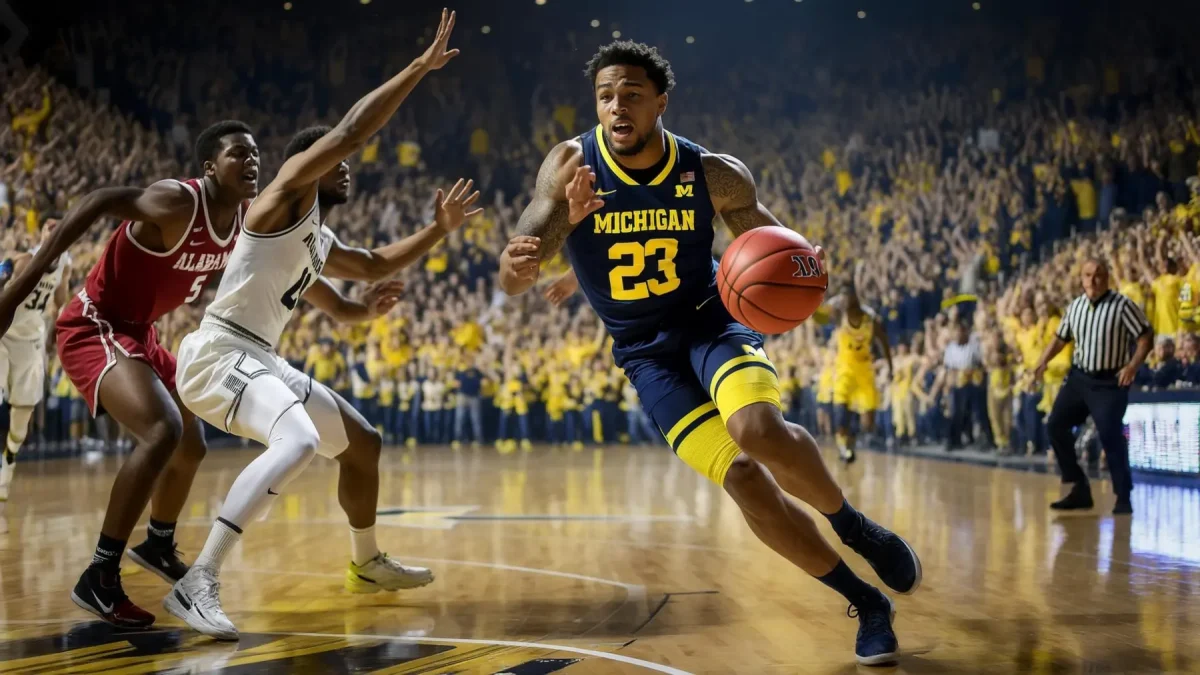
A Michigan fan sitting three rows behind the Alabama bench watched Yaxel Lendeborg catch a lob, finish through contact, and then casually jog back on defense as if he’d done it a hundred times before. In that moment, the score read 71-58, and the outcome was no longer in doubt. What had started as a competitive Sweet 16 matchup had turned into a statement win for the top-seeded Wolverines.
What Is the Michigan 90-77 Alabama (Mar 27, 2026) Game Recap?
On Friday, March 27, 2026, top-seeded Michigan defeated Alabama 90-77 in the NCAA Tournament Sweet 16. The win advanced the Wolverines to the Elite Eight and eliminated the Crimson Tide from the tournament. This game recap covers the key performances, statistical story, and what the result means for both programs heading forward.
Yaxel Lendeborg delivered the performance of the tournament so far, posting 23 points, 12 rebounds, and seven assists in a dazzling all-around effort, according to ESPN. Michigan controlled the glass throughout, finishing with 46 total rebounds to Alabama’s 32. The Wolverines also won the offensive rebound battle 10 to 8, per Yahoo Sports, which translated directly into second-chance points that kept Alabama from making a serious late run.
| Category | Michigan | Alabama |
|---|---|---|
| Final Score | 90 | 77 |
| Total Rebounds | 46 | 32 |
| Offensive Rebounds | 10 | 8 |
| Lendeborg (PTS/REB/AST) | 23/12/7 | — |
| Seed | #1 | Lower seed |
How Did the Game Unfold? The Debate Over Michigan’s Dominance
The central debate after this game is whether Michigan simply executed at a high level, or whether Alabama’s inability to match their physicality exposed a structural weakness in the Crimson Tide’s roster. Both arguments have real merit, and they shape how you evaluate each team’s tournament run.
Side A argues Michigan was simply the better team on every measurable dimension. The Wolverines outrebounded Alabama by 14 boards. Lendeborg was unguardable as a passer, scorer, and rebounder simultaneously.
A fast-break dunk from Nimari Burnett at the 17:04 mark of the second half sparked an 8-0 Michigan run, per MGoBLue.com, that effectively broke Alabama’s resistance. When a team generates that kind of momentum off transition plays, it signals genuine athletic superiority, not just a hot shooting night.
Side B pushes back with a fair point: Alabama still scored 77 points, which is not a defensive embarrassment. The Crimson Tide hit a three-pointer to end Michigan’s 8-0 run and showed they could generate offense. Their argument is that a few key possessions swung the margin, and a different night from their shooters produces a closer game or even an upset.
Why Is This Game Recap Important for Both Programs?
This result matters beyond the box score. For Michigan, advancing to the Elite Eight as a one-seed validates their entire regular season and confirms they have a legitimate Final Four-caliber roster. Lendeborg’s performance specifically signals that Michigan has a player who can dominate in multiple ways against elite competition, not just in conference play.
For Alabama, the loss is a painful exit. According to Roll Tide Wire, the Crimson Tide were eliminated from the NCAA Tournament on Friday evening, ending what had been a strong postseason run. The question Alabama’s coaching staff faces now is roster construction: if you can’t win the rebounding battle against a physical team, do you recruit differently, or do you trust that your offensive efficiency will carry you past that deficiency in future tournaments?
These questions have real recruiting implications. Programs that lose in the Sweet 16 to a team that physically dominated them often see transfer portal activity in the weeks that follow. I’d watch Alabama’s roster moves closely through April 2026, because this loss could accelerate some decisions that were already simmering.
“Yaxel Lendeborg had 23 points, 12 rebounds and seven assists in a dazzling all-around performance, and Michigan beat Alabama 90-77 on Friday night to advance.” — ESPN
The Data: What the Numbers Actually Show
Objective data from this game tells a clear story. Michigan’s rebounding advantage of 46 to 32 is not a marginal edge; it’s a 44 percent margin, which is significant in a game decided by 13 points. Offensive rebounding specifically matters because it resets possessions and keeps defenses from getting into transition. Michigan won that battle 10 to 8, a smaller margin but still in the Wolverines’ favor.
Lendeborg’s stat line of 23 points, 12 rebounds, and seven assists is the kind of performance that earns All-Tournament team recognition. A player who can do all three things at that volume forces defenses into impossible choices: collapse on him in the post and he passes out, guard him on the perimeter and he attacks the glass. Alabama had no consistent answer for that problem across 40 minutes.
- Michigan’s 46 total rebounds were 14 more than Alabama’s 32
- Lendeborg recorded a near triple-double with 23 points, 12 rebounds, and 7 assists
- Nimari Burnett’s fast-break dunk triggered an 8-0 run at the 17:04 mark of the second half
- Alabama’s three-pointer at 15:21 ended the run but couldn’t stop Michigan’s momentum
- Michigan entered as the number one seed; Alabama’s elimination was confirmed by Roll Tide Wire
The 13-point final margin actually understates Michigan’s control. When a team is winning the rebounding battle by that magnitude, the score tends to reflect sustained dominance rather than a late-game flurry. Alabama’s 77 points suggest they were competitive offensively, but they simply couldn’t stop Michigan from getting extra possessions.
Verdict: Michigan Was the Better Team, Full Stop
The debate framing is useful, but the verdict here is not particularly close. Michigan did not win this game because of a hot shooting night or a lucky bounce. They won it because they were physically superior on the glass, had a transcendent individual performance from Lendeborg, and made the right plays at the right moments, including Burnett’s fast-break dunk that turned a competitive game into a rout.
Alabama’s argument that a few possessions could have changed things is technically true of almost every game. But when you lose the rebounding battle by 14, you are not a few possessions away from winning; you are a team that got outworked in the most fundamental area of basketball. I’d respect that argument more if the margin were two or three boards, not fourteen.
CBS Sports framed it well, noting that Lendeborg starred as Michigan beat Alabama in the Sweet 16. That framing is accurate. This was a star performance carrying a team that was already good enough to win without one. That combination is what makes Michigan genuinely dangerous in the Elite Eight and beyond.
Implications: What This Means Going Forward
Michigan’s Elite Eight appearance as a one-seed is expected, but how they got there matters. Winning by 13 while generating 46 rebounds signals a team playing with physical confidence. Their next opponent will have watched this film and know that stopping Lendeborg requires a specific defensive game plan, not just general effort.
For Alabama, the offseason starts now. The Crimson Tide will need to evaluate whether their current personnel can compete with elite rebounding teams, or whether the transfer portal needs to deliver a physically dominant big man before next season. Losing in the Sweet 16 to a team that outrebounded you by 14 is a specific, correctable problem if you recruit the right player.
For college basketball broadly, this game reinforces something that analytics have shown for years: rebounding margin is one of the most predictive stats in tournament play. Teams that consistently win the glass win more games. Michigan understood that assignment. You can follow live tournament updates and bracket results at the official NCAA March Madness page and track Lendeborg’s season stats on ESPN’s college basketball hub.
The broader implication for fans and analysts watching the remaining tournament field: if you want to predict Elite Eight and Final Four outcomes, start with rebounding differential. Michigan’s 14-board advantage over Alabama was not an accident. It was a strategy, executed at the highest level of college basketball.
Frequently Asked Questions



Leave a Reply