
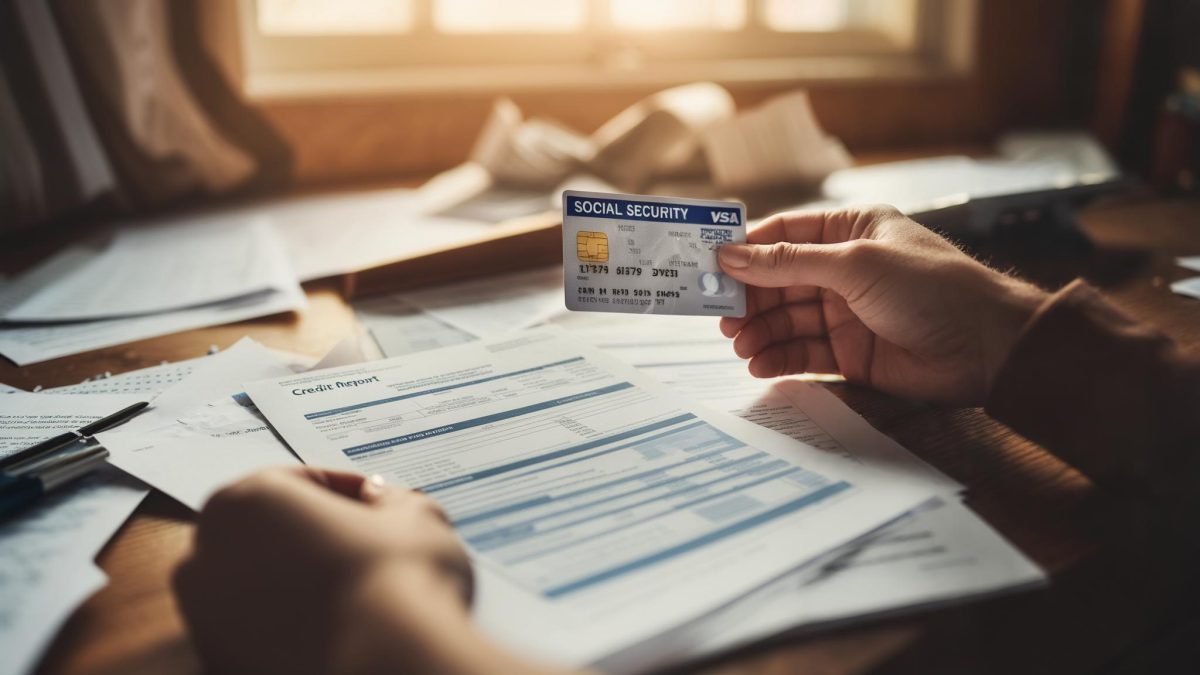
She was comparing prices on a box of cereal when I first noticed the look on her face — the flat, exhausted expression of someone carrying something heavy and refusing to put it down. I struck up a conversation with Marian Valdez in the cereal aisle of an H-E-B in San Antonio on a Tuesday afternoon in late January 2026, and within ten minutes she was telling me something that stopped me cold. Not about her credit score, though that story was bad enough. About her Social Security record.
Marian is 29, a flight attendant based out of San Antonio International, married with three kids. Her husband stays home with the children. She is, by most measures, doing well — earning roughly $87,000 a year, carrying the household on her income. But since the spring of 2024, her financial life has been quietly unraveling in ways that took nearly two years to fully surface.
How One Stolen Number Became a Cascading Crisis
Marian first discovered she was a victim of identity theft in March 2024, when a collections notice arrived for a credit card account she had never opened. A deeper look revealed the scope of the damage: at least six fraudulent accounts had been opened in her name between late 2022 and early 2024, accumulating roughly $34,000 in debt. Her credit score, which she told me had sat comfortably around 760, plummeted to 512 almost overnight.
The timing was brutal. She and her husband had been planning to refinance their home — a 1960s-era bungalow in the Woodlawn Lake neighborhood — to fund a roof replacement that a contractor estimated would cost $18,400. With her credit destroyed, the refinance fell apart. The roof is still waiting.
But the credit damage, as devastating as it was, turned out not to be the worst of it. That discovery came later — almost by accident — when Marian finally sat down and pulled her Social Security Statement through the SSA’s my Social Security portal in September 2025, more than eighteen months after the fraud was first uncovered.
What She Found Inside Her Social Security Statement
Marian had never looked at her Social Security Statement before that September. She told me she’d always figured it was something you checked when you were close to retirement — not at 28. She only logged in because a coworker mentioned it in passing during a layover in Dallas.
What Marian found was a line item showing approximately $22,800 in reported wages for 2023 from an employer she did not recognize — a food processing company in Omaha. Someone had been working under her Social Security number, and that employer had reported those wages to the IRS and the Social Security Administration as hers.
According to the SSA’s guidance on correcting earnings records, errors in your earnings history — whether caused by employer mistakes or fraud — directly affect the benefit calculations for retirement, disability, and survivor benefits. Every dollar of phantom income attached to her record was distorting the picture of what she had actually earned and contributed.
The Process of Disputing Fraudulent Earnings — and Why It’s Harder Than It Sounds
When Marian contacted the Social Security Administration to report the discrepancy, she expected a clear, fast resolution. She did not get one. She told me the first representative she spoke with instructed her to gather W-2s, pay stubs, and tax returns going back to 2022 to prove she hadn’t actually worked in Nebraska. She found the requirement maddening.
She filed a formal earnings discrepancy report with the SSA, submitted her flight crew employment records through her airline’s HR department, and filed an amended tax return with the IRS to remove the fraudulent wages. The process ran parallel tracks — the SSA and IRS do not automatically share corrections — and each required separate documentation.
The IRS component introduced a complication Marian had not anticipated: because the fraudulent wages had been reported under her SSN, she received a CP2000 notice in late 2024 — a letter suggesting she owed additional taxes on income she never received. Responding to that notice added another layer of documentation and another few months to the process.
Where Things Stand Now — and What Still Isn’t Fixed
When I sat down with Marian for a longer follow-up conversation in February 2026, the Social Security piece had been largely resolved. The fraudulent 2023 wages had been removed from her earnings record by January 2026, after roughly four months of back-and-forth with both agencies. She showed me a corrected Social Security Statement on her phone — the Nebraska employer was gone.
The credit damage is a different story. As of our February conversation, her score had climbed back to roughly 631 — meaningful progress, but still well below where she was before the fraud. The refinance she needs to fix the roof remains out of reach at current rates, and she told me the contractor has warned her that delaying the repair risks structural damage to the fascia that would push the cost well above $18,400.
She is pragmatic about what she’s learned, if not exactly at peace with it. The self-reliance that defines her personality — the instinct to handle things herself, to dismiss outside guidance as unnecessary — took a hit during this process. She told me she resisted asking for help for too long, spending months trying to navigate the SSA’s correction process alone before finally calling a nonprofit credit counselor affiliated with the National Foundation for Credit Counseling.
According to the SSA’s Office of the Inspector General, Social Security number misuse in employment situations — where someone works under another person’s SSN — is among the most common forms of identity fraud the agency investigates. Victims often don’t discover the issue until they review their earnings record, sometimes years after the fact, which is exactly what happened to Marian.
The Takeaway Marian Didn’t Expect to Walk Away With
Marian is not someone who has warmed to the idea of checking in on her financial accounts regularly. She told me flatly that she finds the whole exercise tedious and that she still thinks most financial guidance is written for people with more time and money than she has. That stubbornness hasn’t vanished.
But she checks her Social Security Statement now. Every few months, she logs in and looks at the earnings record. It takes about three minutes, she told me, and it’s the one habit she picked up from this whole ordeal that she doesn’t resent.
There is no clean ending to Marian’s story yet. The roof is still leaking around the chimney flashing when it rains hard. Her credit is rebuilding slowly. The financial ground beneath her family is more stable than it was in 2024, but it hasn’t fully returned to what it was before someone in Nebraska decided to borrow her identity for a year and a half.
What I keep thinking about, driving home from that second interview, is how long this went unseen. Marian is sharp, employed, paying attention. And still, a fraudster spent more than a year working under her Social Security number before she had any idea it was happening. The record that will one day determine her retirement benefits was silently accumulating wages she never earned, in a state she’d never visited, for a job she’d never held. It took a coworker’s offhand comment on a layover to start unraveling it.
The SSA allows every American to create a free my Social Security account and review their earnings history at any time. For Marian, that three-minute check is now part of the rhythm of her life — not because anyone told her it was important, but because she learned the hard way what happens when you assume someone else is watching.



Leave a Reply