

The pharmacist was already moving to the next customer when I heard the man at the counter ask, quietly but urgently, whether there was any program that could help him pay for his blood pressure medication. It was a Tuesday afternoon in late January 2026, at a CVS on East Jefferson Avenue in Detroit. I was picking up a routine prescription myself. The man — compact, mid-sixties, wearing a collared shirt with a small embroidered logo I couldn’t quite read — was told to check online or call the manufacturer. He nodded and stepped aside, staring at the bag in his hand.
I introduced myself. His name was Cedric Peralta. He was 62 years old. He owned a small daycare center in the Jefferson-Chalmers neighborhood, had a wife and two kids — a four-year-old and a nine-year-old — and was carrying more financial weight than most people half his age. We exchanged numbers. A week later, I sat across from him at a folding table in his daycare’s back office, surrounded by laminated alphabet posters and a whiteboard full of pickup schedules, and he told me everything.
A Business That Works — On Paper
Cedric opened Little Roots Learning Center in 2018 after completing a graduate degree in early childhood education administration from Wayne State University. The degree cost him roughly $34,000 in federal student loans. At the time, he believed the credential would help him secure grants and contracts with the city of Detroit. He was right — partially. The center currently enrolls 22 children and brings in approximately $8,400 per month in revenue, mostly through a mix of private tuition and Michigan’s Child Development and Care subsidy program.
After payroll for two part-time aides, rent, liability insurance, and supplies, Cedric clears somewhere between $2,100 and $2,600 per month. His wife works part-time as a medical transcriptionist, adding roughly $1,100 monthly. The household income sits in the $3,200 to $3,700 range most months — enough to keep the lights on, but not enough to absorb surprises.
The prescription at the pharmacy — lisinopril for hypertension — was $74 without coverage. His insurance through a small-business health plan had changed in December 2025, and the new formulary placed the medication in a higher tier. “I’ve been taking this pill for four years,” he told me. “I didn’t change anything. The plan just changed around me.”
The Debt That Kept Him Up at Night
The student loan situation was more complicated. Cedric had been on an income-driven repayment plan through most of the early 2020s, but a processing error in 2023 caused his payments to lapse for several months. The loan servicer reported the delinquency. By mid-2024, a separate, older credit card debt from 2017 — roughly $6,200 — had been sold to a collections agency that had filed for a civil judgment in Wayne County Circuit Court. That judgment was granted in September 2024.
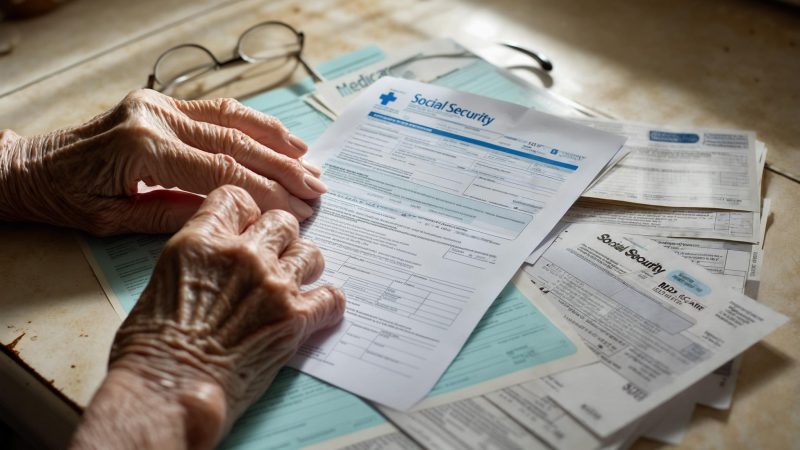
The creditor, Cedric told me, had not yet begun garnishing his business account. But the threat of it happening — combined with the unresolved student loan status — was what was really keeping him awake. His specific fear: that when he eventually claims Social Security, both the judgment creditor and the federal government could take a cut of his monthly benefit before he ever saw a dollar.
His concern is not unfounded. According to the Social Security Administration, Social Security benefits are generally protected from garnishment by private creditors under federal law — but federal debts are a different category entirely. That distinction turned out to be the crux of Cedric’s situation.
What Federal Law Actually Says About Garnishment
The answer to Cedric’s core question — can my Social Security be taken? — depends entirely on who is doing the taking. Private creditors, including the collections agency that holds that 2017 credit card judgment, generally cannot garnish Social Security benefits. Section 207 of the Social Security Act specifically prohibits assignment or levy of benefits by private parties. For Cedric, that was a partial relief.
Federal student loans are different. The federal government can withhold a portion of Social Security benefits to recover defaulted federal student loan debt through a process called Treasury offset. Under the Treasury Offset Program, up to 15 percent of a Social Security benefit can be withheld — though the remaining benefit cannot be reduced below $750 per month.
Cedric’s loans were not technically in default — they were delinquent, which is a different status. But he hadn’t resolved the processing error that caused the lapse, meaning the window for default was still open. “I knew there was a difference between delinquent and default,” he said, “but I didn’t know exactly where I stood, and nobody had told me directly.”
The Prescription Problem and Extra Help
The medication issue was, in some ways, more immediately solvable than the debt question. Cedric is not yet on Medicare — at 62, he’s three years away from age 65 eligibility — but his insurance situation had deteriorated enough that he was functionally paying out of pocket for a medication his doctor had prescribed as essential.
When I asked whether he’d looked into pharmaceutical manufacturer assistance programs, he said he had tried one and been rejected because his household income exceeded the threshold by a small margin. “It was like $200 over the limit,” he told me, shaking his head. “I didn’t know whether to laugh or just leave.”
What Cedric hadn’t fully considered was the trajectory ahead. He is five years from his full retirement age of 67. If he claims Social Security at 62 — his earliest eligible date — his benefit would be permanently reduced by approximately 30 percent compared to waiting until 67. Based on his reported earnings history, his estimated benefit at 62 would be in the range of $980 to $1,050 per month. At 67, that number could climb to roughly $1,400. The difference, over a decade of retirement, adds up to tens of thousands of dollars.
Where Things Stand Now
By the time Cedric and I finished our second conversation — a follow-up call in late February 2026 — he had taken a few concrete steps. He contacted his federal loan servicer and confirmed his loans were delinquent but not yet in default. He had submitted a request to re-enroll in an income-driven repayment plan, which, if approved, would bring his monthly payment to approximately $0 given his current adjusted gross income. That wouldn’t erase the debt, but it would stop the clock on default.
The credit card judgment is still outstanding. Cedric told me the collections attorney had sent a second letter in February, this time referencing the possibility of a bank levy on his business account. “I can’t ignore it,” he said, “but I also don’t have $6,200 sitting somewhere I can just hand over.” He’s looking into whether a payment arrangement might satisfy the creditor and pause the levy action. That part remains unresolved.
What struck me most, sitting in that back office with the laminated letters on the wall, was how much of Cedric’s situation had been shaped not by reckless decisions but by the gap between how government benefit programs are designed and how a working person actually experiences them. His loans slipped into delinquency because of a servicer error he didn’t catch in time. His insurance changed because a small-business plan restructured its formulary. His garnishment fear was real — but only partially accurate, and nobody had ever explained the distinction to him.
Cedric is still five years from any Medicare coverage and five years from an unreduced Social Security benefit. Whether he makes it to 67 without pulling from his retirement early depends on a lot of variables he’s still trying to nail down — a business that stays solvent, a debt situation that doesn’t spiral, and a medication he can afford to keep taking. He’s methodical about all of it. He has the spreadsheets to prove it. But some variables, as he told me the day we met, just don’t fit neatly into a cell.
Related: The $14,000 Loan She Cosigned Destroyed Her Path to Social Security at 62



Leave a Reply