

Roughly one in four Americans between the ages of 58 and 64 have never once reviewed their Social Security earnings record, according to estimates from the Social Security Administration. Crystal Hensley was one of them — until last October, when a single statement printed from a government website upended the retirement plan she had been quietly building in her head for years.
Crystal reached out to me after reading a story I published last fall about a Charlotte woman who discovered a decade of missing earnings on her Social Security record. The email she sent was brief and direct: “I think something similar happened to me, but I’m not sure what I’m looking at.” We met at a diner near her apartment in Raleigh on a Tuesday morning in November 2025. She arrived early, ordered black coffee, and kept her phone face-down on the table the entire time we talked.
A Life Built on Hard Work — and a Few Invisible Gaps
Crystal Hensley is 61 years old and has worked as a licensed HVAC technician for the better part of three decades. She is single, owns her tools outright, and for the past four years has been the primary caregiver for her mother, who is 84 and lives about twenty minutes away. The caregiving is unpaid. The expenses — prescription co-pays, occasional home health aides, grocery runs — are not.
She told me she sends roughly $600 to $800 a month toward her mother’s needs, sometimes more when a medical bill lands unexpectedly. That number has been a fixture in her budget for years, and it has meant that her own retirement savings have grown slowly. “I don’t regret it,” Crystal said. “But I was telling myself the Social Security check would make up the difference. I had a number in my head. Turns out I made that number up.”
Crystal’s projected benefit at her full retirement age of 67 came out to approximately $1,580 per month — nearly $390 less than the round number she had been mentally budgeting around. The gap traced back to two distinct periods: a two-year stretch in the mid-2000s when she worked primarily as a 1099 contractor and did not consistently file self-employment taxes, and a partial year in 2017 when she cut her hours significantly to manage a family health crisis. Those quieter years left real dents in her 35-year earnings average, which is exactly what the SSA uses to calculate benefits.
The Trust Problem That Almost Kept Her From Looking
Crystal was not oblivious to Social Security. She knew roughly what it was, knew she had paid into it, and had a general sense that she should probably check her record at some point. What kept her from doing it was something harder to quantify: a deep wariness of government institutions and financial systems born from a specific experience she has not fully let go of.
In 2011, Crystal refinanced her home through a mortgage broker she had been referred to by a neighbor. She said the broker misrepresented the terms of the loan, and she spent the next three years fighting to avoid foreclosure. She eventually lost the house in 2014. “After that, I didn’t trust anyone who had my information and wanted something from me,” she told me. “Even if it was the government. Especially if it was the government.”
She finally created a my Social Security account in October 2025, more than a decade after the SSA made the online portal widely available. She said she did it on a Saturday morning when she was “in the right mood” — skeptical but ready. What she found was not fraud or missing wages on the scale she feared, but it was still a surprise that landed hard.
What the Statement Actually Revealed
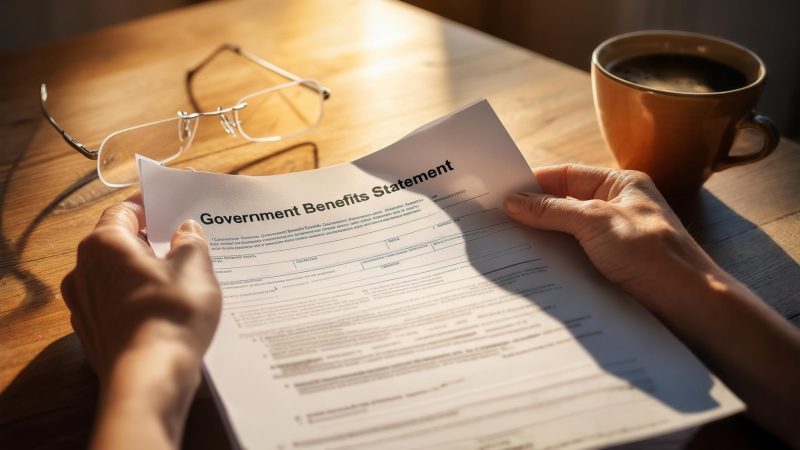
When I asked Crystal to walk me through what she saw, she pulled a printed copy of her statement from her jacket pocket. She had highlighted two lines. The first was her earnings record for 2005 and 2006, which showed significantly lower figures than her surrounding years — roughly $18,000 combined across both years, compared to $38,000 to $44,000 in the years on either side. The second was the projected monthly benefit figure.
The SSA calculates retirement benefits by averaging a worker’s 35 highest-earning years, adjusting for inflation. Years with zero or very low earnings count as zeroes in that average, dragging the final number down. For Crystal, those contractor years were not zeroes — she had filed taxes in both years — but they were low enough to pull her lifetime average down measurably. According to the SSA’s benefit calculation methodology, even a single low-earning year can reduce a final monthly benefit by $30 to $80 depending on where it falls in the earnings history.
Crystal also noted something she had not expected: the statement showed three different benefit amounts depending on the age she claimed. At 62, the earliest possible filing age, her projected monthly benefit dropped to roughly $1,105. At 67 — her full retirement age — it was $1,580. And if she waited until 70, delayed retirement credits would push that figure to approximately $1,960. The range between the earliest and latest claiming ages was nearly $855 per month — a number she described as “genuinely shocking.”
The Health Insurance Problem That Complicates Everything
The benefit shortfall was one problem. The health insurance gap is another, and for Crystal, the two are intertwined in ways that make her timeline harder to navigate than a simple spreadsheet would suggest.
Crystal has no employer-sponsored health insurance. As a self-employed HVAC technician, she purchases a plan through the Affordable Care Act marketplace. In 2025, that plan cost her $487 per month with a $4,200 deductible. She described it as “barely insurance” — something she pays for and hopes never to actually use.
Medicare doesn’t start until age 65. If Crystal chose to claim Social Security at 62 to ease her financial pressure, she would still face three years of marketplace premiums on top of a reduced monthly benefit. If she waits until 67 or 70 to maximize her benefit, she needs to keep covering her own insurance costs until Medicare kicks in at 65 — and then manage a two-to-five-year window with no Social Security income at all.
“Every option has a catch,” she told me, leaning back in her chair. “I feel like I’m being punished for not having a regular job with regular benefits. I’ve worked thirty years. I shouldn’t feel this uncertain.”
Where Crystal Stands Now
Crystal did not leave our conversation with a clear plan. That was not the point of her reaching out, and I want to be honest about what I can offer here — a reporter’s account of her experience, not guidance on what she should do next. What she did have, by the time we finished talking, was a clearer picture of what she was actually working with.
She said she plans to request a free appointment with her local SSA office to ask specific questions about her earnings record — particularly those two low-income contractor years — and whether anything can be amended. She is not optimistic. “I’m not expecting anyone to fix it,” she said. “I just want to understand it fully before I make any decisions.”
She also mentioned, almost as an afterthought, that she has started setting aside an additional $200 per month since October. Not in a retirement account, not in a brokerage — in a separate savings account she can see. “I don’t trust things I can’t see,” she said. For Crystal, that transparency is not a character flaw. It is a survival strategy earned through hard experience.
When I left the diner that Tuesday, Crystal was still sitting at the table, her printed statement smoothed flat in front of her, the two highlighted lines visible from across the room. She looked less like someone who had received bad news and more like someone who had finally stopped avoiding it. That distinction, she told me before I left, mattered more than she expected it to.
“I spent years not looking because I was scared of what I’d find,” she said. “Turns out the not-knowing was worse.”



Leave a Reply